
Accident Injury Law Firm: How Our Personal Injury Lawyers Help You Secure Maximum Compensation
An accident injury law firm represents people hurt by another party’s negligence and works to secure full compensation for medical bills, lost wages, pain and suffering, and future care needs. This article explains how these firms evaluate claims, gather proof, negotiate with insurance companies, and prepare cases for trial when needed, so readers understand each step of the process and what outcomes to expect. Many injured people confront aggressive insurer tactics, unclear liability rules, and time limits such as statutes of limitations; skilled personal injury lawyers reduce those risks by handling evidence collection, expert witnesses, and settlement valuation. You will learn which services firms provide, how to choose the right lawyer, the typical claim timeline, what damages are recoverable, immediate post-accident actions to protect your claim, and how a firm’s contingency model and free consultations make legal help accessible. Throughout, the guide uses practical checklists, EAV tables, and comparative criteria so you can make informed decisions after a car, truck, motorcycle, slip-and-fall, or wrongful-death accident. By the end you’ll have a clear map of the legal path from intake to resolution and the concrete steps to preserve value in your claim.
What Services Does an Accident Injury Law Firm Provide?
An accident injury law firm provides comprehensive legal services that include case evaluation, investigation, negotiation with insurers, and litigation when necessary to secure compensation. These services operate by identifying negligence, compiling medical and scene evidence, aligning expert opinions, and applying civil litigation procedures to obtain fair settlements or verdicts for clients. The direct benefit to an injured person is professional management of complex interactions with insurance companies and medical providers so the client can focus on recovery. Below is a concise list of the core services most firms offer and why each matters to case outcomes.
- Case evaluation and free consultation: Assess liability, damages, and evidence to determine viable claims.
- Investigation and evidence gathering: Collect police reports, medical records, witness statements, and scene documentation.
- Demand preparation and negotiation: Build demand packages and negotiate with adjusters to maximize settlement value.
- Litigation and trial representation: File suit, manage discovery, and present cases to juries when settlements fail.
- Medical and rehabilitation coordination: Arrange medical experts and future-care planning to quantify long-term needs.
These services form an integrated process that moves from intake to resolution, and understanding them leads directly into the specific accident types firms typically handle.
Which Types of Accident Claims Do We Handle?
Accident injury law firms handle a broad range of claims—auto accidents, car and truck collisions, motorcycle crashes, slip-and-fall incidents, wrongful death claims, and medical malpractice are common categories. Each accident type is a hyponym of personal injury law and presents unique liability questions: commercial truck cases often involve carrier regulations and employer vicarious liability, while slip-and-fall claims focus on property owner duty and notice.
The mechanism by which the firm advances each case varies: for motorcycle crashes the firm may emphasize helmet laws and eyewitness corroboration, whereas for medical malpractice it will retain medical experts to establish the standard of care breach. Recognizing the specific legal levers for each accident type improves evidence selection and valuation strategies and prepares clients for the next phase—specialized technical support.
How Does Our Legal Team Support Auto, Truck, and Motorcycle Accident Victims?
For vehicle-accident victims, a firm combines accident reconstruction, medical coordination, and insurance negotiation to protect claim value and support recovery. Accident reconstructionists and EDR/ELD data analysts reconstruct impact dynamics, which directly links to liability and damages calculations; commercial truck claims add regulatory investigations into driver logs and carrier responsibilities.
The legal team coordinates with treating physicians and specialists to document injuries such as whiplash, TBI, or spinal trauma and quantifies both current and future medical needs. Effective negotiation with insurers for commercial carriers and personal auto policies often depends on presenting clear liability narratives and expert-backed care plans, which then naturally leads into how to select a lawyer who can execute these strategies.
How Do You Choose the Right Personal Injury Lawyer for Your Accident Case?
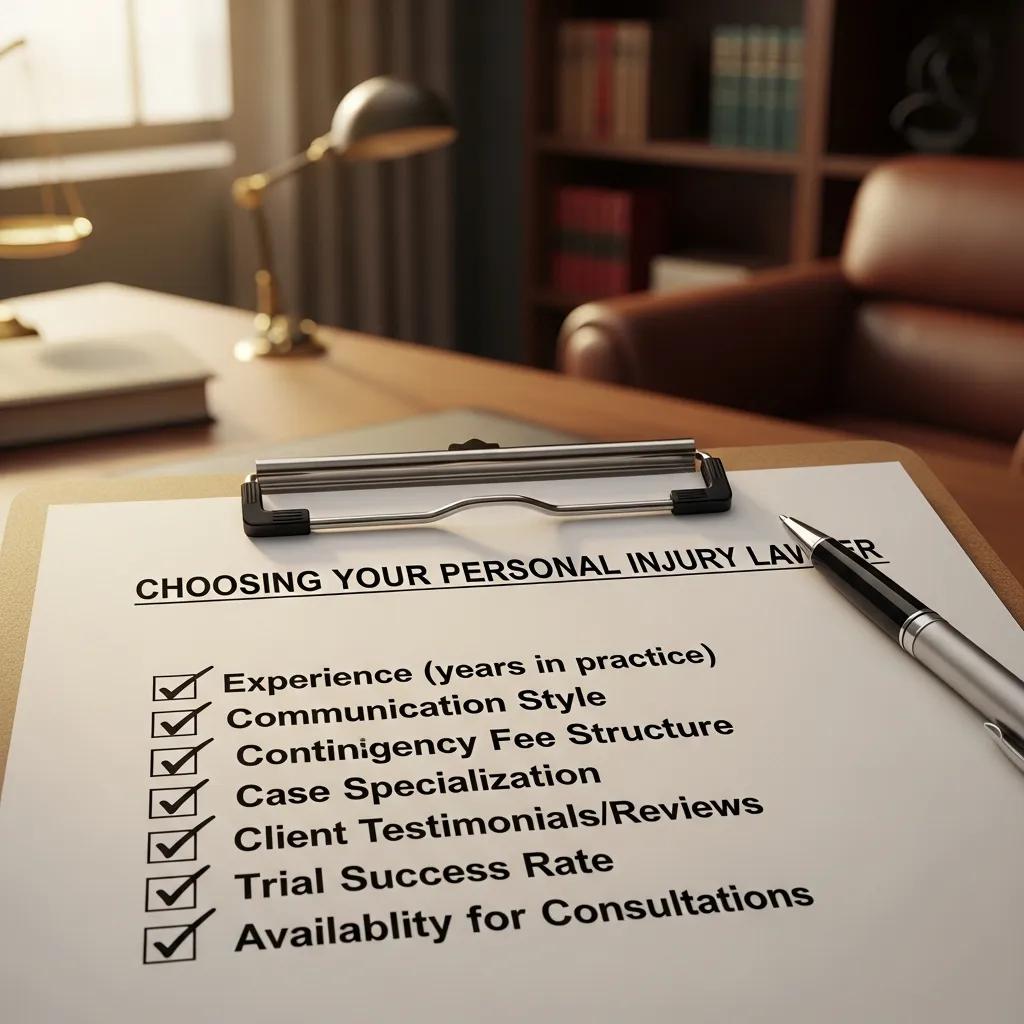
Choosing the right personal injury lawyer depends on clear selection factors: relevant experience, documented case results, transparent contingency-fee terms, communication style, and local knowledge of courts and insurers. These selection factors matter because they directly influence case strategy, evidence acquisition, and settlement expectations; experience with similar injury types (e.g., TBI, spinal cord injury) means the attorney understands valuation drivers and expert networks. Below is a practical checklist of the five most important criteria to use during consultations to compare attorneys quickly and effectively.
- Relevant Experience: Ask about cases like yours and outcomes to assess familiarity with similar injuries. For example, our firm’s founder, Ed Akhavan, brings over 15 years of dedicated personal injury experience to every case.
- Case Results & Resources: Confirm access to experts, investigators, and medical networks used in prior wins.
- Contingency Fee Clarity: Ensure the fee structure, case costs, and “No Win, No Fee” conditions are explained.
- Communication & Responsiveness: Look for clear timelines, regular updates, and a direct contact person.
- Local Knowledge: Prefer attorneys who know local judges, defense counsel, and insurer practices.
Use these factors to prioritize interviews at free consultations, and the next table helps compare selection factors with red flags and positive indicators for each.
| Selection Factor | Why It Matters | Positive Indicator / Red Flag |
|---|---|---|
| Experience with injury type | Improves valuation and expert selection | Positive: similar case wins / Red flag: generic practice, no specifics |
| Case resources | Determines investigative and trial capacity | Positive: in-house investigators / Red flag: dependent on subcontractors |
| Fee transparency | Aligns incentives and avoids surprises | Positive: written contingency agreement / Red flag: vague cost language |
| Communication | Affects client confidence and case management | Positive: clear contact plan / Red flag: slow replies |
| Local knowledge | Influences negotiation strategy and trial approach | Positive: local court experience / Red flag: no local track record |
This comparison table clarifies how selection factors map to actionable questions for consultations and naturally guides you toward evaluating firm differentiators and case results.
What Factors Should You Consider When Hiring an Injury Attorney?
When hiring an injury attorney, prioritize concrete indicators such as prior settlements and verdicts for similar injuries, the availability of medical and forensic experts, transparent contingency arrangements, and client communication protocols. These attributes determine whether the attorney will pursue full damages or accept lowball insurer offers, since case valuation depends on convincing evidence and expert testimony rather than promises.
Ask specific questions during a free consultation: who will handle day-to-day communication, what are estimated timelines, and how are litigation costs advanced and recouped under “No Win, No Fee”? Evaluating answers to these questions reduces semantic ambiguity about responsibilities, and the next subsection explains why experience plus compassion matters for both outcomes and client experience.
Why Is Experience and Compassion Important in an Accident Injury Law Firm?
Experience, such as that of our founder Ed Akhavan, who has over 15 years in personal injury law, brings litigation strategy, knowledge of expert networks, and familiarity with insurer tactics that materially affect case value; compassion ensures clients follow treatment plans and communicate openly, which directly supports proof of damages. Litigation and settlement both rely on consistent medical care and documented symptoms, so an attorney who balances legal skill with empathetic client management typically preserves stronger evidence and achieves higher valuations.
Example outcomes often hinge on the firm’s ability to coordinate long-term care planning and explain medical records to a jury, while compassionate counsel helps clients endure protracted negotiations or trial preparation. That blend of technical competence and human-centered service shapes expectations about the claim process and preparation steps that follow.
What Is the Personal Injury Claim Process with an Accident Injury Law Firm?
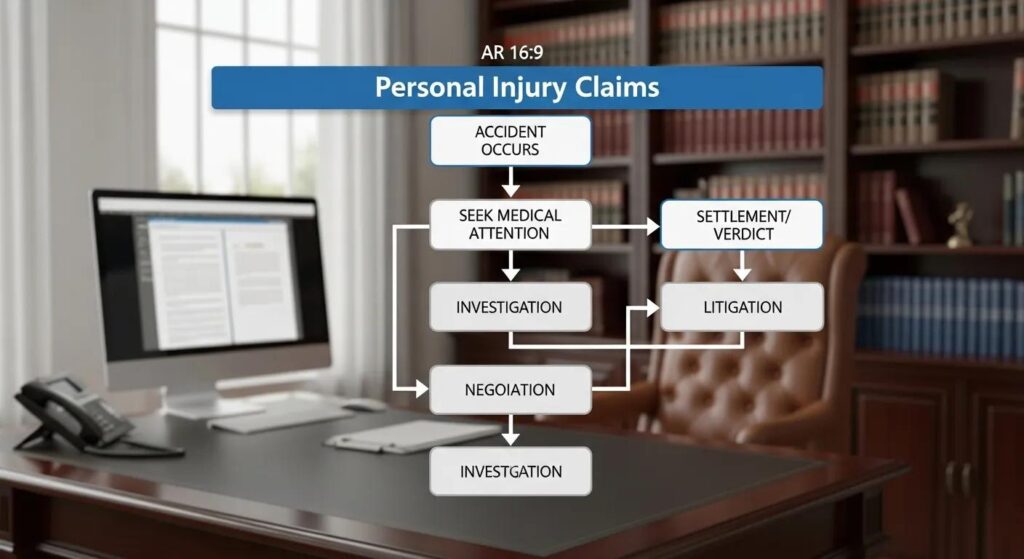
The personal injury claim process moves from an initial intake and investigation through demand, negotiation, and potential trial, with the firm orchestrating evidence, experts, and timelines to meet statutory deadlines. This process matters because clear stages—investigation, medical documentation, demand, negotiation, and trial preparation—structure client responsibilities and set realistic expectations for resolution timing and outcomes. Below is a step-by-step summary designed for quick reference and featured-snippet clarity, followed by a compact EAV timeline table to map responsibilities and typical timelines.
- Intake & free consultation: Evaluate liability, damages, and statute of limitations.
- Investigation & evidence gathering: Secure police reports, medical records, and expert analysis.
- Demand & negotiation: Present a demand package and negotiate with insurers.
- Litigation & trial prep: File suit if needed, conduct discovery, and prepare witnesses.
- Settlement or verdict: Settle through negotiation or pursue trial for unresolved disputes.
| Stage | What Happens | Client Action / Typical Timeline |
|---|---|---|
| Intake & Evaluation | Case screening and legal strategy | Provide initial documents; 1–2 weeks |
| Investigation | Collect records, interviews, expert review | Attend medical appointments; 1–3 months |
| Demand & Negotiation | Send demand package to insurer | Review offers with attorney; 1–6 months |
| Litigation | File suit, discovery, motions | Participate in testimony if needed; months–years |
| Resolution | Settlement or trial verdict | Finalize release and distribution |
This timeline table shows responsibilities at each stage and the typical cadence of actions, which leads into a practical explanation of costs and contingency arrangements.
What Are the Key Steps from Consultation to Settlement or Trial?
Key steps begin with a free consultation to confirm a viable claim, followed by a structured investigation that secures police reports, medical records, and witness statements to prove negligence and damages. Next the firm prepares a demand package that quantifies economic and non-economic losses and negotiates with adjusters; if negotiations stall, the firm files suit and proceeds through discovery and trial preparation. Time-sensitive actions include preserving surveillance footage and filing before the statute of limitations expires, so clients must follow recommended medical care and document expenses promptly. Understanding these steps demystifies the process and prepares clients for the contingency-fee mechanics described next.
How Does the “No Win, No Fee” Guarantee Work?
“No Win, No Fee” typically means the attorney represents clients on a contingency basis—attorney fees are a percentage of the recovery and are only due if the client obtains a settlement or verdict—while the firm may advance case costs and disbursements during litigation. This model aligns incentives because the attorney’s compensation depends on maximizing the recovery; however, clients should clarify whether case costs are deducted before or after the attorney’s percentage is applied and what happens if there is no recovery.
A plain-language example: if a settlement is $100,000 and the contingency fee is 33%, the attorney’s fee would be $33,000 plus agreed-upon costs; if there is no recovery, most contingency arrangements mean the client owes no attorney fee but may still be responsible for certain advanced costs only if agreed. Knowing these details at the outset reduces surprises and encourages timely legal action, including scheduling a free consultation to confirm case viability.
What Types of Compensation Can You Recover After an Accident Injury?
After an accident, recoverable compensation typically falls into economic damages (medical expenses, lost wages, future care) and non-economic damages (pain and suffering, emotional distress); punitive damages may apply in cases of egregious misconduct. Economic damages are meronyms of total compensation and are proven with bills, pay stubs, and expert cost projections, while non-economic damages rely on valuation techniques such as multipliers or per diem approaches to estimate intangible losses. Understanding how each damage type is calculated helps plaintiffs set realistic expectations and supports negotiation strategies with insurers. The following EAV-style comparison table clarifies what each compensation type covers and gives example calculation notes.
| Compensation Type | What It Covers | Example / How Calculated |
|---|---|---|
| Medical Expenses | Past and future treatment costs | Sum of bills; future care via expert life-care plan |
| Lost Wages | Earnings lost and diminished earning capacity | Pay stubs for past loss; vocational expert for future loss |
| Pain & Suffering | Non-economic physical and emotional harm | Multiplier method (1.5–5× economic damages) or per diem |
| Future Care Costs | Long-term rehabilitation and assistive needs | Life-care plan + present-value calculation |
| Punitive Damages | Punishment for egregious conduct | Rare; depends on state law and misconduct severity |
This table demonstrates how entities (compensation types) relate to attributes (coverage) and values (examples/calculation), and sets up the next subsection that explains common valuation methods and settlement ranges.
How Are Medical Expenses, Lost Wages, and Pain and Suffering Calculated?
Medical expenses are calculated by totaling past bills and estimating future care with medical experts and life-care plans, while lost wages use payroll records and projections of diminished earning capacity when injuries affect future work. Pain and suffering uses valuation models—commonly a multiplier of economic damages or a per diem rate reflecting daily impairment—with factors such as injury severity, recovery duration, and permanent impairment affecting the multiplier selection.
Documentation required includes medical records, invoices, employer statements, and expert testimony for future-cost estimates; robust documentation increases settlement leverage with insurers. Recent industry data through early 2024 shows rising medical-cost baselines, making precise future-cost modeling increasingly important to preserve claim value.
What Are Common Settlement Amounts for Car and Truck Accident Claims?
Settlement amounts vary widely based on severity, liability clarity, insurance policy limits, and documented economic and non-economic losses, so typical ranges are illustrative rather than predictive. Minor injury claims may resolve for low four-figure sums, moderate injuries with significant medical bills and lost wages often settle in mid-to-high five figures, and severe catastrophic injuries or wrongful death claims can reach six or seven figures when future care and lifetime lost earnings are factored.
Key drivers of settlement size include the strength of liability evidence, completeness of medical records, presence of catastrophic injuries (TBI, spinal cord), and the defendant’s available insurance limits. Because every case is unique, early legal evaluation helps estimate a realistic range and identify negotiation levers that affect settlement outcomes.
What Should You Do Immediately After an Accident to Protect Your Injury Claim?
Immediate actions after an accident preserve evidence, protect health, and strengthen future claims; priority steps are seeking medical care, documenting the scene, notifying authorities, and gathering witness information. These steps work because contemporaneous records, photos, and witness statements create a clear chain of evidence that links negligence to injuries and damages. The checklist below targets the essential first actions to reduce risk of evidence loss and insurer disputes, followed by a short explanation of why early legal advice matters for preserving surveillance, filings, and deadlines.
- Seek immediate medical attention: Even if injuries seem minor, timely documentation links treatment to the accident.
- Call law enforcement and obtain a police report: Official reports create an early liability record.
- Document the scene: Take photos of vehicle damage, road conditions, and visible injuries.
- Collect witness contact information: Witness statements corroborate your account of events.
- Avoid admitting fault: Statements that sound like acceptance of blame can be used against you.
Taking these steps helps secure physical and testimonial evidence that will be vital during investigation and negotiation, and the next subsection explains how early legal advice amplifies these protections.
What Are the Essential First Steps to Take After a Car or Slip and Fall Accident?
After a car crash, prioritize safety and medical assessment, exchange insurance information without admitting fault, photograph the damage and scene, and collect witness names and contact details; for slip-and-fall incidents, photograph hazards, report the incident to property management, and seek medical care while requesting incident reports. Each action preserves distinct evidence: photos capture environmental factors and injury appearance, incident reports create official records, and witness contacts enable later corroboration, all of which strengthen causation and liability arguments.
Avoid common mistakes such as signing statements for insurers without legal review or accepting quick settlements that ignore future care; instead document expenses and continue follow-up treatment to establish the injury trajectory. These immediate steps set up evidence collection that legal counsel will later use to prepare a demand and negotiate effectively.
How Can Early Legal Advice Improve Your Case Outcome?
Early legal advice helps preserve crucial evidence—surveillance footage, witness availability, and medical referrals—and prevents insurer tactics that could undermine claims, such as recorded statements taken without counsel or premature settlement offers. An attorney can coordinate timely subpoenas for footage, retain experts to conduct prompt investigations, and advise on medical providers who can document injuries in ways insurers accept, thus directly influencing case valuation.
Engaging counsel early reduces the risk of missed deadlines like statutes of limitations and ensures that treatment and documentation align with litigation needs, which increases settlement leverage. Given these benefits and to remove financial barriers to consultation, many firms offer free consultations and operate on a contingency, “No Win, No Fee” basis—making early legal advice accessible without upfront attorney fees.
How Does Our Accident Injury Law Firm Stand Out From Competitors?
This section describes firm differentiators and client-facing benefits: free consultations, a contingency-fee or “No Win, No Fee” model, an experienced and compassionate legal team, focused practice areas (auto, truck, motorcycle, slip and fall, wrongful death, medical malpractice), and a process that emphasizes communication and verified case results. These unique value propositions remove financial barriers, align incentives, and provide clients with the resources needed to pursue maximum compensation. Key trust signals include attorney profiles that highlight relevant experience with similar injury types, anonymized case-result summaries showing settlement ranges, and a client communication plan that guarantees timely updates—factors that help prospective clients evaluate likely fit and outcome. If you are considering legal representation after an accident, the following list summarizes the principal benefits to expect.
- Free Consultation: Assess case viability and strategy without cost or obligation.
- Contingency / “No Win, No Fee”: Aligns attorney incentives with client recovery.
- Specialized Practice Areas: Teams focused on vehicle crashes, catastrophic injury, and premises liability.
- Transparent Case Results: Anonymized summaries that illustrate typical outcomes and valuation drivers.
These benefits collectively reduce client risk and provide clear next steps, and the subsections below explain how free consultations work and how profiles and case results should be presented to build trust.
What Are the Benefits of Our Free Consultations and Contingency Fee Model?
Free consultations let prospective clients present facts, receive an initial legal assessment, and learn whether a case meets thresholds for damages and liability without financial commitment, which eliminates a common barrier to seeking counsel. The contingency or “No Win, No Fee” model aligns attorney incentives with client recovery because legal fees are typically collected as a percentage of any settlement or verdict, meaning the attorney is motivated to maximize compensation. During a consultation, clients should expect an explanation of how costs are advanced, how fees and disbursements are handled if a recovery occurs, and an initial strategy outline. This transparent approach helps clients focus on recovery and evidence preservation while the firm handles negotiation and litigation tasks.
How Do Our Attorney Profiles and Case Results Demonstrate Expertise?
Attorney profiles should include focused experience descriptions, areas of practice, and representative anonymized case results that identify injury types, liability context, and outcome ranges without breaching client confidentiality. Presenting case results in a standardized format—injury type, primary damages, and anonymized settlement or verdict amount—helps prospective clients understand how similar cases were valued and what evidence mattered. Profiles that highlight trial experience, expert networks, and prior successful negotiations convey practical capacity to take cases to verdict if needed. Clear presentation of these elements supports informed decision-decision-making at the free consultation stage and creates realistic expectations about case timelines and potential recoveries.
Disclaimer: The information provided on this page is for general informational purposes only and should not be considered legal advice. Reading this page, using this website, or contacting us through this page does not create an attorney-client relationship. Every legal matter is different, and the information here may not apply to your specific situation. You should not act or rely on any information on this page without first consulting a qualified attorney about your individual case.