On this page
- Executive Summary
- 3 Core Insights
- What a No-Cost Consult Actually Covers (and What It Doesn’t)
- How Local Crash Claims Are Proven: Liability, Causation, Damages
- Evidence That Disappears Fast (and the Deadlines to Preserve It)
- Documents to Bring So the Attorney Can Evaluate Your Case in One Meeting
- Questions to Ask to Confirm the Lawyer Is “Local-Ready” for Your Courts and Adjusters
- Core Case Timeline: What Happens After You Hire Counsel
- Damages: How Attorneys and Insurers Calculate Claim Value in Practice
- Cost and Fee Mechanics: What “No Upfront Fees” Usually Means
- Red Flags That Your “Free Consult” Won’t Help You (and What to Do Instead)
- When Specialized Experience Matters: Rideshare, Trucks, Pedestrians, and Fatal Collisions
- Why “Personal Injury Lawyer” Credentials and Ethics Rules Matter
- Smart Next Steps After the Meeting: Lock in Evidence, Treatment Continuity, and Communication
- Final Takeaway: Use the Free Consult to Stress-Test the Case Before the Insurer Does
- Frequently Asked Questions
- Don’t Let “Free Consultation” Cost You the Case
Executive Summary
A car accident lawyer near me free consultation is a no-cost intake meeting to quickly assess fault, medical causation, and damages, then map out a deadline-aware evidence and claim strategy before you sign any fee agreement. The best consultations focus on fast evidence preservation (video/911/vehicle data), clean medical and wage-loss documentation, and a clear plan for costs and communication.
3 Core Insights
- It’s a case “stress test,” not a guarantee: The consult screens liability, causation, and damages to identify weaknesses early, but it does not promise representation or a settlement value without complete records.
- Speed matters because key evidence disappears: Traffic and business video, 911 audio/CAD logs, and vehicle event/telematics data can be overwritten or lost quickly, so preservation letters and targeted requests should be discussed immediately.
- Bring proof and confirm the process: Arrive with crash, medical, and wage-loss documents and ask who advances case costs, how demand packages are built for local adjusters/courts, and what communication cadence you will receive.
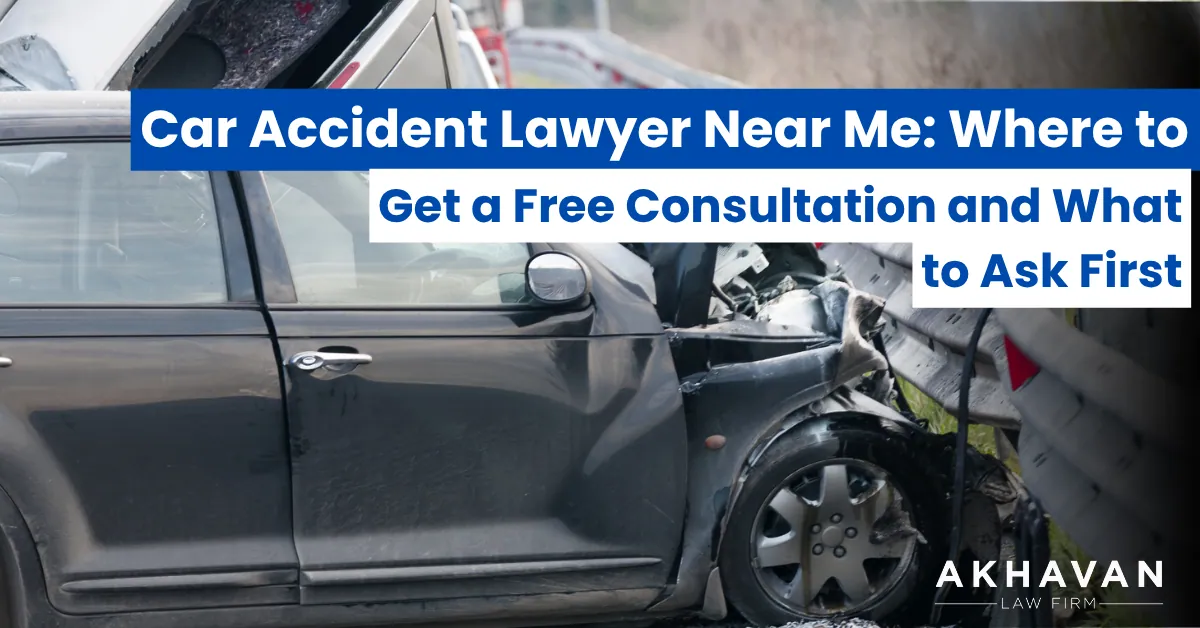
A car accident lawyer near me free consultation is a no-cost first meeting with a local personal injury attorney to review your crash facts, screen liability, and outline next steps before you sign any contract. Start with nearby options that routinely handle motor-vehicle claims in your area’s courts and insurance markets. Bring your crash report number from the local police department, scene photos showing lane markings and impact points, and the other driver’s insurance card details. Include your ER discharge papers, imaging results, and billing statements, plus wage-loss proof such as pay stubs or a time-off letter. Ask first whether the attorney can pull the full police report, 911 call logs, and nearby traffic-camera or business surveillance footage, and how fast those requests must be made before recordings auto-delete. Confirm how they calculate damages using local medical pricing, common repair estimates, and documentation standards used by regional adjusters. Ask who pays for up-front case costs like record retrieval, crash reconstruction, and expert reviews, and whether reimbursement comes only from a settlement. Verify the deadline rules they track, including notice requirements, claim filing timelines, and the practical schedule for treatment, demand packages, negotiations, and lawsuit filing if talks stall. Finally, ask for a clear plan for communication, including who you will call day-to-day, how often you will receive updates, and what happens if the insurer disputes fault, alleges comparative negligence, or argues gaps in care.
What a No-Cost Consult Actually Covers (and What It Doesn’t)
A free consultation is a fact-and-document review designed to evaluate liability, insurance coverage, and the practical value of a claim before any fee agreement is signed. It is not a promise of representation, a guarantee of a settlement amount, or a substitute for medical care.
In most motor-vehicle injury intakes, the attorney uses your timeline, impact mechanics, and treatment history to decide whether the evidence supports: (1) fault, (2) causation (that the crash caused the injuries), and (3) provable damages. If any one of those pillars is weak, the consult is where you find out early—before you spend months waiting on an insurer that intends to deny or minimize the claim.
- Typically included: initial liability screening, coverage check planning, document checklist, statute/notice issue spotting, and next-step strategy.
- Typically not included: writing demand letters on the spot, contacting witnesses immediately during the meeting, or giving you a “final” valuation without records.
How Local Crash Claims Are Proven: Liability, Causation, Damages
Successful cases are built on a three-part proof structure: who was negligent, whether that negligence caused injury, and how much the injury cost in money and human impact. Your consultation should map your facts into this structure so there is a clear plan for evidence collection.
In car collisions, liability often turns on objective materials (police diagram, vehicle damage patterns, electronic data, roadway markings) and credibility anchors (consistent statements, consistent treatment). Causation is commonly attacked through “minor impact” arguments, pre-existing conditions, gaps in care, or delayed symptom reporting, so your medical timeline matters as much as crash photos.
- Liability: traffic-law violation, unsafe speed, distracted driving, failure to yield, unsafe lane change, impaired driving, or following too closely.
- Causation: EMS notes, ER records, imaging, primary-care follow-up, PT/chiro notes, ortho/neuro referrals, and symptom consistency.
- Damages: medical bills, future care needs, wage loss, loss of earning capacity, property damage, and pain/suffering documentation.
Evidence That Disappears Fast (and the Deadlines to Preserve It)
The first week after a crash is often the most important evidence window because many recordings and digital logs are routinely overwritten. A consultation should identify what can be preserved and who must be contacted immediately.
Video footage from nearby businesses, residential doorbells, and traffic-adjacent cameras can be lost quickly if no preservation request is sent. Phone data, vehicle event data, and rideshare app logs can also become harder to obtain as time passes, especially if you don’t know the precise identifiers (time, location, trip ID, vehicle VIN).
- Commonly time-sensitive items:
- Traffic-camera and business surveillance video (often auto-overwritten on short cycles).
- 911 call audio and CAD logs (subject to agency retention rules and request processing time).
- Vehicle event data recorders (EDR) and telematics (may require prompt inspection to avoid loss after repairs/total-loss handling).
- Scene conditions: skid marks, gouge marks, debris fields, temporary signage, construction zones.
- Practical consult question: “Will you send preservation letters immediately, and to whom (businesses, agencies, towing yards, insurers, rideshare providers)?”
Documents to Bring So the Attorney Can Evaluate Your Case in One Meeting
The fastest way to get a useful consult is to show the attorney liability proof, medical proof, and income proof in a clean timeline. If you can’t get everything, bring what you have and a list of where the rest can be requested.
Most claim delays come from missing records and unclear treatment chronology. If your paperwork is organized, the attorney can identify gaps and tell you exactly which providers and facilities must be contacted.
- Liability & crash documentation:
- Crash report number and the agency name that responded (police, CHP, sheriff).
- Scene photos, vehicle photos, dashcam clips, and any witness contact info.
- Other driver’s insurance card and driver’s license information (photos help).
- Medical documentation:
- ER/urgent care discharge papers, imaging results (CT/MRI/X-ray), and follow-up instructions.
- Itemized billing statements and EOBs if health insurance paid portions.
- Prescription receipts and assistive device receipts (braces, crutches).
- Income and life-impact proof:
- Pay stubs, direct deposit records, or employer letter confirming missed work and rate of pay.
- Calendar notes showing appointments, missed events, and activity restrictions.
Questions to Ask to Confirm the Lawyer Is “Local-Ready” for Your Courts and Adjusters
A nearby attorney adds value when they understand local filing procedures, typical defense strategies used in the region, and documentation standards demanded by insurers that operate in your market. The consultation should reveal whether the firm has an actual plan for your venue and your type of collision.
Insurers evaluate claims using internal guidelines and local medical cost benchmarks; courts apply strict procedural rules once litigation begins. You are looking for clear, process-based answers—not sales language.
- Case handling: “Who will handle my file day-to-day, and who signs pleadings if a lawsuit is filed?”
- Investigation: “Will you obtain the full police report, 911 logs, and video evidence, and how quickly?”
- Medical proof: “How do you document future care, referrals, and causation where symptoms evolve over time?”
- Damages presentation: “Do you use itemized bill summaries, records chronologies, and treating-provider narratives in your demand packages?”
- Cost structure: “Are case costs advanced, and are they reimbursed only from settlement or verdict proceeds?”
Core Case Timeline: What Happens After You Hire Counsel
Most injury claims move through a predictable workflow: investigation, treatment stabilization, demand, negotiation, and—if needed—litigation. A consult should provide a real timeline that accounts for medical care, evidence collection, and statutory deadlines.
Timing is not just about “how long a settlement takes”; it’s about when the case is mature enough to value. Settling too early can undercut recovery if additional treatment, complications, or work restrictions appear later.
- Phase 1: Intake & preservation — conflict check, retainer, insurance notices, preservation letters, record requests.
- Phase 2: Treatment & documentation — consistent follow-up, specialist referrals as indicated, wage-loss confirmation.
- Phase 3: Demand package — liability narrative, medical chronology, bills, wage loss, exhibits, and settlement demand.
- Phase 4: Negotiation — counteroffers, lien/medical bill resolution planning, settlement drafting.
- Phase 5: Lawsuit (if needed) — complaint, service, discovery, depositions, expert review, mediation/MSC, trial prep.
If you want a concrete walkthrough of what to do immediately after a collision, review the steps you need to take after an auto accident and compare it to what your prospective attorney recommends in your intake.
Damages: How Attorneys and Insurers Calculate Claim Value in Practice
Claim value is driven by documented medical care, provable wage loss, and credible pain-and-suffering evidence tied to functional limitations. Your consult should explain how those categories are supported with records and how liens and reimbursements affect net recovery.
Insurers commonly scrutinize treatment gaps, inconsistent complaints, and “excessive treatment” allegations. A lawyer should describe how they present medical necessity and address pre-existing conditions with clear causation documentation.
- Economic damages:
- Past medical expenses (itemized billing + payment history).
- Future medical expenses (treatment plan and, when appropriate, specialist support).
- Lost wages (employer verification + wage records).
- Loss of earning capacity (work restrictions and occupational impact evidence).
- Out-of-pocket costs (receipts, mileage logs, medical devices).
- Non-economic damages:
- Pain, physical limitations, sleep disruption, and reduced daily functioning (documented consistently over time).
- Emotional distress tied to the injury experience (often supported by treatment notes when applicable).
- Property-related issues:
- Repair estimates, total-loss valuation documents, and rental car receipts.
- Diminished value arguments where applicable (requires careful documentation).
Cost and Fee Mechanics: What “No Upfront Fees” Usually Means
Most injury representations are contingency-based, but case costs are a separate category that should be explained in plain terms. The consult should identify which costs are advanced and how reimbursement is handled at settlement.
Typical cost items include medical record retrieval, filing fees, service of process, deposition transcripts, and expert consultations. You should know whether the firm advances these costs, whether you may be responsible if there is no recovery, and how medical liens are negotiated.
| Feature / Metric | Specifications | Local Guidelines |
|---|---|---|
| Contingency fee structure | Attorney fee is a percentage of recovery, governed by the signed fee agreement and applicable ethics rules. | Ask for the percentage at pre-suit vs. after filing, and whether it changes if trial or appeal occurs. |
| Case costs (advanced expenses) | Records, filing fees, service, investigators, depositions, experts, exhibits. | Confirm if costs are advanced by the firm and reimbursed only from recovery, and get it in writing. |
| Medical liens & reimbursements | Potential repayment claims from health insurers, Medicare/Medi-Cal, or providers on lien. | Ask who negotiates reductions and how lien resolution affects the net settlement to you. |
| Evidence preservation | Preservation letters, public records requests, spoliation prevention steps. | Confirm how quickly letters go out and whether investigators are used for witness and video canvassing. |
| Litigation readiness | Capacity to file suit, conduct discovery, retain experts, and proceed to trial if needed. | Ask how they handle insurer lowballing and comparative-fault defenses in your venue. |
Red Flags That Your “Free Consult” Won’t Help You (and What to Do Instead)
Some consultations are designed to close you quickly rather than evaluate your claim carefully. You can protect yourself by watching for specific process failures that typically lead to missed evidence or undervalued demands.
You should leave the meeting knowing (1) what evidence will be gathered next, (2) what medical documentation is needed, and (3) what deadlines matter. If you leave with only generic assurances, keep looking.
- Red flag: Promising a settlement number before reviewing medical records and billing.
- Red flag: No questions about prior injuries, treatment gaps, or symptom onset (these are predictable insurer attack points).
- Red flag: No plan to preserve video, request 911 logs, or identify witnesses.
- Red flag: Unclear answers about who handles your file and how often you’ll get updates.
When Specialized Experience Matters: Rideshare, Trucks, Pedestrians, and Fatal Collisions
Not all crashes are evaluated the same way because coverage, defendants, and evidence sources change by crash type. If your case involves a commercial vehicle, app-based driver, or a death, your consult should focus on layered insurance and faster evidence preservation.
For example, trucking cases often require prompt spoliation letters for driver logs and vehicle data, while rideshare claims require identifying the app “period” (offline, available, en route, passenger onboard) because that status can affect insurance. If your collision involved a commercial vehicle, consider reviewing a dedicated truck accident service page to compare what specialized case handling looks like.
- Rideshare (Uber/Lyft): trip status verification, app records, layered policies, and driver history.
- Commercial trucks: carrier policies, safety compliance materials, and vehicle/driver documentation preservation.
- Pedestrians/bicyclists: right-of-way proof, visibility factors, and injury severity documentation.
- Wrongful death: estate/heir issues, economic support calculations, and heightened evidentiary requirements.
Why “Personal Injury Lawyer” Credentials and Ethics Rules Matter
Personal injury representation is regulated by attorney ethics rules, fee agreement requirements, and court procedures that affect your rights and deadlines. A consultation should include transparent fee terms, realistic case assessment, and a plan for communication.
If you want a baseline definition of the role and scope of this practice area, review the standard description of a personal injury lawyer and then compare it to what your prospective attorney actually does in investigation, negotiation, and litigation.
Smart Next Steps After the Meeting: Lock in Evidence, Treatment Continuity, and Communication
The best consult ends with a checklist you can act on immediately: preserve evidence, maintain consistent treatment, and avoid insurer traps that harm credibility. You should also know exactly how to reach the office and what updates you’ll receive.
Insurers often request recorded statements, broad medical authorizations, and quick releases. Your legal strategy should prioritize accurate documentation and controlled communication so the claim is built on verifiable records.
- Preserve: back up photos/videos, write down witness names, and note exact time/location details while memory is fresh.
- Treat consistently: follow discharge instructions, attend referrals, and document symptom changes in medical visits.
- Track losses: keep wage-loss proof, mileage, receipts, and a simple activity-limitation journal.
- Control communications: do not sign broad releases or give recorded statements without understanding the purpose and scope.
- Confirm the update plan: ask for a standard cadence (e.g., after records arrive, after demand submission, after each insurer response).
Final Takeaway: Use the Free Consult to Stress-Test the Case Before the Insurer Does
A strong free consultation produces a concrete evidence plan, a medical documentation roadmap, and a deadline-aware claim strategy tailored to your local courts and insurers. Your goal is to leave with clarity on fault proof, causation support, damages documentation, cost handling, and communication expectations.
When you compare attorneys, prioritize the one who identifies disappearing evidence early, explains how demands are built from records (not guesses), and is prepared to litigate if negotiations stall—because that posture is what forces serious evaluation from insurers.
Frequently Asked Questions
Don’t Let “Free Consultation” Cost You the Case
After a crash, the clock starts running on the stuff that actually proves what happened. Traffic and business cameras overwrite footage. 911 audio and dispatch logs follow retention rules. Vehicles get repaired or totaled before anyone downloads event data. Meanwhile, the insurance company is already building a file designed to pay as little as possible—often by leaning on “minor impact” arguments, treatment gaps, pre-existing condition claims, and comparative-fault finger-pointing.
Trying to handle this yourself can feel “straightforward” right up until you realize the evidence is gone, your documentation is incomplete, and the adjuster is using your own words (or a rushed recorded statement) to dispute fault or minimize your injuries. By the time you’re ready to “get serious,” you may be fighting an uphill battle with missing video, unclear medical timelines, and deadlines you didn’t know existed.
A local car accident attorney can move fast where it counts: preservation letters to the right places, targeted record requests, a clean treatment and wage-loss chronology, and a damages strategy that matches what local adjusters and courts actually accept. You should walk away from the consult with a real plan—what gets requested, when it gets sent, who does it, what it costs, and how you’ll be updated if the insurer stalls or denies.
Disclaimer: The information provided on this page is for general informational purposes only and should not be considered legal advice. Reading this page, using this website, or contacting us through this page does not create an attorney-client relationship. Every legal matter is different, and the information here may not apply to your specific situation. You should not act or rely on any information on this page without first consulting a qualified attorney about your individual case.

Edwin E. Akhavan is the founding attorney of Akhavan Law Firm APC, a personal injury law firm in Beverly Hills, California. State Bar of California #270338. About the firm