On this page
- Executive Summary
- Core Insights
- How “top-rated” truck crash attorneys are commonly ranked in Los Angeles
- What elite truck-accident case handling looks like in the first 30 days
- Key evidence categories in commercial truck cases (and why they matter)
- Los Angeles-specific litigation realities: venues, procedure, and leverage points
- California deadlines and fault rules that directly affect truck crash value
- What the best lawyers do differently when insurers push early low settlements
- Core comparison table: what you should verify before hiring
- Fee structures and cost realities in LA truck litigation
- When the “truck accident” label hides other high-liability defendants
- Why verified results matter—and how to read them responsibly
- Personal injury representation standards you should expect
- Choosing the right Los Angeles truck crash lawyer: a disciplined selection checklist
- Bottom line: what “top-rated” should mean for your case in 2026
- Frequently Asked Questions
- Don’t Let a Trucking Company’s “Normal Retention Policy” Destroy Your Case
Executive Summary
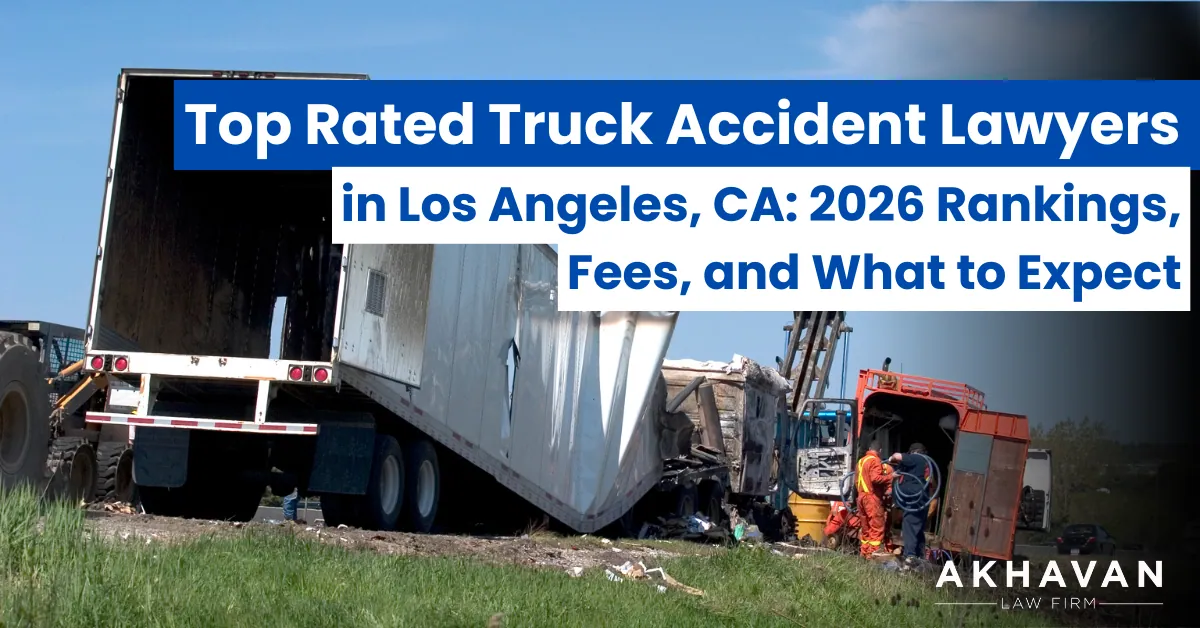
Top rated truck accident lawyers in Los Angeles are typically identified by verifiable case outcomes, trucking-specific litigation capability, and disciplined early evidence preservation that prevents FMCSA-related records and electronic data from disappearing. In practice, the “top” choice is the lawyer who can move fastest in the first days, prove liability with trucking compliance evidence, and litigate effectively in Los Angeles County civil courts when the carrier resists.
Core Insights
- Rankings should be verifiable: Prioritize attorneys whose “top-rated” claims are supported by public results, consistent client feedback, peer credibility (not pay-to-play badges), and a clean State Bar discipline history.
- The first 30 days decide evidence strength: The best truck-crash firms immediately send spoliation letters and secure ELD/telematics, ECM/EDR downloads, dispatch logs, DQFs, maintenance/DVIRs, Part 382 testing records, and third-party video before routine overwrites, repairs, or deletions.
- Los Angeles procedure and leverage matter: Strong counsel understands local venues like the Stanley Mosk Courthouse, prepares for multi-defendant discovery fights, explains deadlines (including Government Claims Act timing), and manages comparative-fault tactics common on I-5, I-10, I-405, SR-60, SR-91, and port drayage corridors.
Top rated truck accident lawyers in Los Angeles are plaintiff-side personal injury attorneys who focus on commercial truck crash claims and who are ranked highly based on verified case results, peer reviews, client feedback, and disciplinary history. This 2026 guide explains how local rankings are commonly determined in Los Angeles County, including trial verdicts and high-value settlements in the Stanley Mosk Courthouse and other civil venues, plus documented trucking-litigation experience involving FMCSA compliance. Strong candidates usually handle evidence that disappears fast, including ELD data, ECM “black box” downloads, dispatch logs, driver qualification files, maintenance and DVIR records, load manifests, weigh-station and toll scans, and drug-and-alcohol testing records under 49 CFR Part 382. Expect early scene work using CHP traffic collision reports, 911 audio, nearby Caltrans camera footage when available, and inspections of underride guards, brakes, tires, and conspicuity tape. Fees are typically contingency-based, often around 33% to 40% depending on whether a lawsuit is filed, arbitration is used, or a trial occurs, with separate case costs for experts such as accident reconstructionists, biomechanical engineers, and life-care planners. You should also expect a clear explanation of California deadlines and notices, including the two-year personal injury statute of limitations, shorter claim windows for government defendants, and how comparative fault can affect payout after collisions on I-5, I-10, I-405, SR-60, SR-91, and port corridors tied to drayage traffic near San Pedro and Wilmington.
How “top-rated” truck crash attorneys are commonly ranked in Los Angeles
Local “best of” lists typically reward measurable outcomes (verdicts/settlements), demonstrated trucking-specific litigation experience, and a clean disciplinary record. In Los Angeles County, credibility is also tied to familiarity with the Stanley Mosk Courthouse’s civil process and the defense players that regularly appear in commercial vehicle cases.
When you evaluate a lawyer’s ranking claims, look for criteria that can be independently verified:
- Public case results tied to catastrophic injury, wrongful death, or complex liability (multiple defendants, corporate policies, or product issues).
- Peer recognition (trial lawyer organizations, invitations to speak on trucking litigation, or leadership roles) without relying solely on “pay-to-play” badges.
- Client feedback patterns that reference specifics—communication, speed of action, and willingness to litigate—rather than generic praise.
- Disciplinary history checks through the State Bar of California (confirm active status and look for past discipline).
- FMCSA and evidence preservation track record shown by early spoliation letters, prompt inspection requests, and motion practice when carriers resist discovery.
What elite truck-accident case handling looks like in the first 30 days
The first month often determines whether critical electronic and paper evidence is preserved or lost. Strong plaintiff counsel moves immediately to lock down data sources that carriers and insurers may overwrite under routine retention policies.
Actions that signal a serious trucking-litigation practice include:
- Immediate preservation/spoliation notice to the motor carrier, driver, broker/shipper (if implicated), maintenance vendor, and insurer demanding retention of ESI and hard-copy records.
- Rapid scene and vehicle investigation using photographs, measurements, mapping, and (when needed) 3D scanning before road conditions change.
- Government and third-party record capture (CHP traffic collision report, 911 audio, tow/impound logs, and nearby business surveillance requests).
- Medical and wage-loss documentation set up early to avoid gaps in causation: EMS records, ER imaging, treating-provider narrative, and employer verification.
In Los Angeles freeway collisions involving commercial vehicles, time matters because:
- ELD and telematics data can be overwritten by fleet systems.
- ECM/EDR (“black box”) downloads may require access to the tractor before it is repaired or salvaged.
- Dashcam and yard camera footage often auto-deletes in days or weeks.
- Maintenance and inspection records can be fragmented across terminals and third-party shops.
Key evidence categories in commercial truck cases (and why they matter)
Truck crashes are won or lost on documentation that connects driver conduct and company policy to the collision mechanics. A top Los Angeles truck injury lawyer should be able to identify every record category that tends to prove fatigue, speeding, improper hiring, negligent maintenance, or unsafe dispatch.
Common evidence targets include:
- Hours-of-service and fatigue indicators
- Electronic Logging Device (ELD) data and edits
- Dispatch instructions, trip sheets, route plans, and appointment times
- Fuel receipts, toll/scale tickets, gate logs (to cross-check logs)
- Driver qualification and safety history
- Driver Qualification File (DQF) under federal motor carrier safety rules
- Training records, prior incidents, and safety evaluations
- Vehicle condition and maintenance
- Maintenance, repair, and inspection history
- DVIRs (Driver Vehicle Inspection Reports) and out-of-service documentation
- Tire, brake, and lighting/conspicuity records
- Substance testing records
- Post-accident and random testing documentation governed by 49 CFR Part 382
- Cargo and loading
- Load manifests, bills of lading, weight tickets, seal logs
- Securement documentation and cargo claims history
These sources are used to prove liability theories such as negligent hiring/retention, negligent entrustment, negligent maintenance, violations of safety rules, and—where supported—punitive damages facts (for example, conscious disregard of safety through repeated violations or forcing unrealistic schedules).
Los Angeles-specific litigation realities: venues, procedure, and leverage points
Truck cases in Los Angeles frequently require comfort with high-volume civil dockets and aggressive discovery practice. Counsel should be prepared to litigate in the Stanley Mosk Courthouse and other local civil venues while managing complex defense teams retained by national insurers.
Practical local considerations include:
- Fast-moving defense “response playbooks” (early recorded-statement requests, broad medical authorizations, and attempts to shift fault to the injured party).
- Multiple defendants (driver, motor carrier, trailer owner, maintenance contractor, shipper/broker, and sometimes a public entity for roadway design/maintenance issues).
- Proof-heavy damages because severe-injury cases often involve future care, long-term wage loss, and permanent impairment.
If a collision involves a government defendant (for example, roadway condition issues on a state route), the time to act can be far shorter than the standard personal injury statute. Counsel should explain the applicable notice rules and deadlines in plain terms at intake.
California deadlines and fault rules that directly affect truck crash value
Truck accident claims are controlled by strict filing deadlines and a comparative fault framework that can reduce recovery if the injured person is assigned partial responsibility. A qualified attorney will calendar every limitation period immediately and build the record to minimize fault allocation.
Core rules to confirm with any lawyer you interview:
- Personal injury statute of limitations: generally two years from the date of injury (California Code of Civil Procedure § 335.1).
- Wrongful death statute of limitations: generally two years (commonly analyzed under the same section and related case law).
- Government claims: claims against public entities often require a pre-suit government claim on a shorter timeline under the Government Claims Act (the lawyer should identify the correct deadline based on defendant identity and facts).
- Comparative fault: California uses pure comparative negligence, meaning damages can be reduced by the percentage of fault assigned to the plaintiff.
On heavily trafficked corridors like I-5, I-10, I-405, SR-60, and SR-91—plus port drayage routes through San Pedro and Wilmington—fault disputes often center on lane-change dynamics, following distance, speed differentials, and visibility issues involving trailers and blind spots.
What the best lawyers do differently when insurers push early low settlements
Early offers in truck cases are often priced before the defense sees a fully documented life-care plan, future wage loss analysis, and the complete electronic evidence picture. High-performing plaintiff firms typically decline to negotiate seriously until core liability and damages proof is secured.
Signals of a stronger negotiation posture include:
- Immediate retention of the right experts when facts warrant it:
- Accident reconstruction (including speed analysis and visibility studies)
- Human factors (perception-reaction timing, conspicuity)
- Biomechanical engineering (injury mechanics where disputed)
- Life-care planning and vocational economics (future losses)
- Structured demand packages with exhibits that insurers can evaluate:
- Medical chronology, imaging index, and treating doctor opinions
- Proof of past and future wage loss
- Photographic timeline (vehicles, injuries, scene, repairs)
- Liability summary cross-referenced to FMCSA-related documentation
- Readiness to file when the carrier refuses to produce records voluntarily.
For background on how injury cases are evaluated and negotiated, see how car accident cases are settled, which outlines common settlement stages that also apply—often with higher stakes—in commercial vehicle litigation.
Core comparison table: what you should verify before hiring
This checklist converts the most important selection factors into verifiable metrics. Use it in consultations to compare attorneys on investigation speed, trucking-specific knowledge, and litigation capacity.
| Feature / Metric | Specifications | Local Guidelines |
|---|---|---|
| Preservation actions | Spoliation letter(s) sent to carrier/insurer and any broker/shipper; requests to preserve ELD, ECM/EDR, dashcam, dispatch, DQF, maintenance, DVIRs, and Part 382 testing records | Ask what is sent in the first 24–72 hours and whether counsel pursues emergency inspection when repair/salvage is likely |
| Trucking-regulation fluency | Ability to explain why FMCSA-style records matter (log integrity, dispatch pressure, maintenance compliance, drug/alcohol testing) | Have them identify which records typically prove fatigue or unsafe scheduling in LA port/drayage and long-haul contexts |
| Courtroom readiness | Demonstrated trial practice, motion work (compel discovery, protective orders, sanctions where warranted) | Confirm experience litigating in Los Angeles County civil courts and comfort handling multiple corporate defendants |
| Damages development | Use of life-care planners, vocational experts, and economists where injuries are permanent or disabling | Ask how future medical care is projected and what documents are used to prove future earning capacity loss |
| Fee and cost transparency | Clear contingency percentage explanation; written breakdown of litigation costs (experts, depositions, exhibits) | Request a written fee agreement and ask how costs are handled if there is no recovery |
Fee structures and cost realities in LA truck litigation
Most truck injury claims are handled on contingency, but the real financial question is how the firm funds the heavy cost burden of proving liability and damages. You should receive a written agreement describing both the contingency fee and how advanced case costs are treated.
What to confirm in writing:
- Contingency percentage and whether it changes if a lawsuit is filed or the case goes to trial.
- Case costs that may be advanced by the firm:
- Accident reconstruction and downloads (ECM/EDR)
- Depositions (court reporter, videographer)
- Medical record retrieval and imaging fees
- Expert witness fees (life-care planning, vocational, economics)
- Cost repayment terms if there is no recovery (some firms absorb certain costs; others may not).
When the “truck accident” label hides other high-liability defendants
Commercial collisions can involve more than a driver and motor carrier, and expanding the defendant list is often the difference between an underinsured case and a fully compensated one. A thorough investigation identifies every party that had control over safety, maintenance, or scheduling.
Common additional defendants in Los Angeles trucking matters include:
- Trailer owners and leasing companies (equipment condition, maintenance responsibilities).
- Maintenance and repair vendors (negligent inspections, brake or tire service errors).
- Brokers/shippers (negligent selection, unsafe pickup/delivery scheduling, load securement issues depending on facts and contracts).
- Manufacturers (defective underride guards, braking components, or lighting—case-specific and evidence-driven).
If your incident involves a commercial vehicle, it is typically handled as a dedicated truck accident claim because the evidence set and defendants differ substantially from ordinary passenger-car collisions.
Why verified results matter—and how to read them responsibly
Past results can indicate litigation capability, but they do not guarantee outcomes because every case turns on liability facts, insurance, injuries, and proof. The right way to use results is to evaluate whether the firm has successfully handled comparable injury severity and complexity.
A practical approach:
- Match the fact pattern: freeway rear-end underride, lane-change sideswipe, multi-vehicle pileup, jackknife, or pedestrian impact.
- Match the injury profile: fractures with surgery, spinal injury, TBI, amputation, burns, or wrongful death.
- Confirm procedural posture: settlement pre-suit, settlement after filing, arbitration, or verdict.
As an example of a truck-related case result discussion, review couple receives $5.7 million verdict in truck accident to see how outcomes are typically summarized and why the underlying liability and damages proof matters.
Personal injury representation standards you should expect
Truck accident cases are a subset of personal injury law, and the baseline professional duties—competence, communication, loyalty, and diligence—still control. The difference is the volume of evidence and the need for immediate, technically informed action.
At a minimum, counsel should provide:
- Prompt communication and a plan for evidence preservation.
- Clear explanations of claims process steps: investigation, demand, filing, discovery, settlement conferences/mediation, and trial.
- Informed consent before major decisions (settlement, expert retention, and litigation strategy shifts).
For a general overview of what a personal injury lawyer does, it can help to compare baseline responsibilities with the specialized demands of commercial vehicle litigation.
Choosing the right Los Angeles truck crash lawyer: a disciplined selection checklist
The best hiring decision comes from verifying investigation capability, trucking-case experience, and trial readiness—not from advertisements. Use a short list of objective questions and require specific, process-based answers.
Bring these questions to consultations:
- “What evidence will you preserve in the first week, and how?” (Listen for ELD/ECM, dispatch, DQF, maintenance/DVIRs, Part 382 testing, and third-party video.)
- “Will you inspect the tractor/trailer, and who performs the download?” (They should describe qualified experts and chain-of-custody steps.)
- “How do you handle comparative fault allegations?” (They should discuss scene evidence, biomechanics/human factors when needed, and disciplined client statements.)
- “What is your plan if the carrier refuses records?” (Look for readiness to file, seek protective orders, and compel discovery.)
- “How are fees and costs handled in writing?” (Expect a transparent contingency agreement and cost explanation.)
Bottom line: what “top-rated” should mean for your case in 2026
In Los Angeles, the attorneys who consistently rise to the top in truck collision litigation are those who preserve electronic and paper evidence immediately, understand the trucking compliance ecosystem, and are prepared to litigate hard in county civil courts. Your goal is to hire counsel whose process is built for high-stakes proof: fast preservation, rigorous expert work, and disciplined damages documentation.
If you evaluate firms using verifiable criteria—State Bar status, documented case results, trucking-evidence competence, and written fee transparency—you will avoid superficial rankings and choose representation that is structurally equipped for catastrophic-injury trucking claims on LA’s freeways and port corridors.
Frequently Asked Questions
Don’t Let a Trucking Company’s “Normal Retention Policy” Destroy Your Case
After a serious truck crash in Los Angeles, you’re not just dealing with an insurance adjuster—you’re up against a system designed to move fast, control the narrative, and quietly let key evidence expire. ELD logs get overwritten. Dashcam and yard footage auto-deletes. Trucks get repaired or salvaged. Witnesses disappear. And once that proof is gone, it’s not “harder” to win—it’s often impossible to prove the full story of what really happened.
Trying to handle this on your own (or with a lawyer who doesn’t regularly litigate commercial truck cases) can cost you in ways you won’t see until it’s too late: missed preservation steps, no immediate inspection, no black-box download, weak demands, and a settlement offer that’s priced as if your injuries—and the company’s responsibility—were “unclear.” Meanwhile, the defense is already building comparative-fault arguments around lane changes, following distance, visibility, and “sudden stop” theories—especially on corridors like I-5, I-10, I-405, SR-60, and SR-91, and near port drayage routes in San Pedro and Wilmington.
If you want real leverage, you need a local team that treats the first 72 hours like they matter—because they do. That means immediate spoliation letters, rapid scene and vehicle work, targeted requests for dispatch and DQF files, maintenance and DVIR records, Part 382 testing documentation, and a litigation plan that assumes the carrier won’t cooperate voluntarily.
Disclaimer: The information provided on this page is for general informational purposes only and should not be considered legal advice. Reading this page, using this website, or contacting us through this page does not create an attorney-client relationship. Every legal matter is different, and the information here may not apply to your specific situation. You should not act or rely on any information on this page without first consulting a qualified attorney about your individual case.

Edwin E. Akhavan is the founding attorney of Akhavan Law Firm APC, a personal injury law firm in Beverly Hills, California. State Bar of California #270338. About the firm