On this page
- Executive Summary
- 3 Core Insights
- How Liability Is Determined in a Beverly Hills Chain-Reaction Collision
- Key California Laws and Procedures That Control Multi-Car Claims
- Evidence That Actually Moves the Needle in a Pileup Investigation
- Medical Causation in Multiple Impacts: Linking Each Crash Pulse to Each Injury
- Insurance Coverage: Why Multi-Policy Cases Get Complicated Fast
- Compensation Categories Typically Pursued After a Beverly Hills Pileup
- Core Investigation Timeline: What to Do in the First 7–30 Days
- Structured Snapshot: What Insurers and Attorneys Evaluate in Multi-Vehicle Claims
- When Multi-Vehicle Crashes Involve Commercial, Rideshare, or Transit Defendants
- How Legal Representation Changes the Outcome in a Multi-Impact Case
- Clear Next Steps After a Beverly Hills Multi-Vehicle Crash
- Frequently Asked Questions
- Don’t Let a Multi-Car Crash Turn Into a Multi-Company Runaround
Executive Summary
Liability in a Beverly Hills chain-reaction collision is resolved by reconstructing the precise impact sequence and applying California’s pure comparative negligence to assign fault percentages across drivers and policies. The strongest outcomes come from early preservation of objective timing and positioning evidence, paired with medical documentation that links specific injuries to specific crash pulses.
3 Core Insights
- Fault Is Built on Sequence, Not Assumptions: Investigators and insurers focus on the initiating negligent act and any later contributing errors, then apportion percentages under pure comparative negligence based on measurable proof like speed, following distance, lane-change timing, and roadway geometry.
- Objective, Time-Stamped Evidence Drives Payout Decisions: Traffic Collision Reports, 911 CAD logs, surveillance video, body-worn camera footage, EDR data, and crush-pattern analysis routinely outweigh conflicting driver recollections and can prevent blame-shifting between multiple insurers.
- Medical Causation and Coverage Mapping Decide Claim Value: Recovery depends on documenting a consistent treatment timeline that ties each injury to a specific impact while simultaneously identifying every applicable policy layer (liability, UM/UIM, rideshare/commercial, umbrella) and avoiding consent-to-settle and recorded-statement pitfalls.
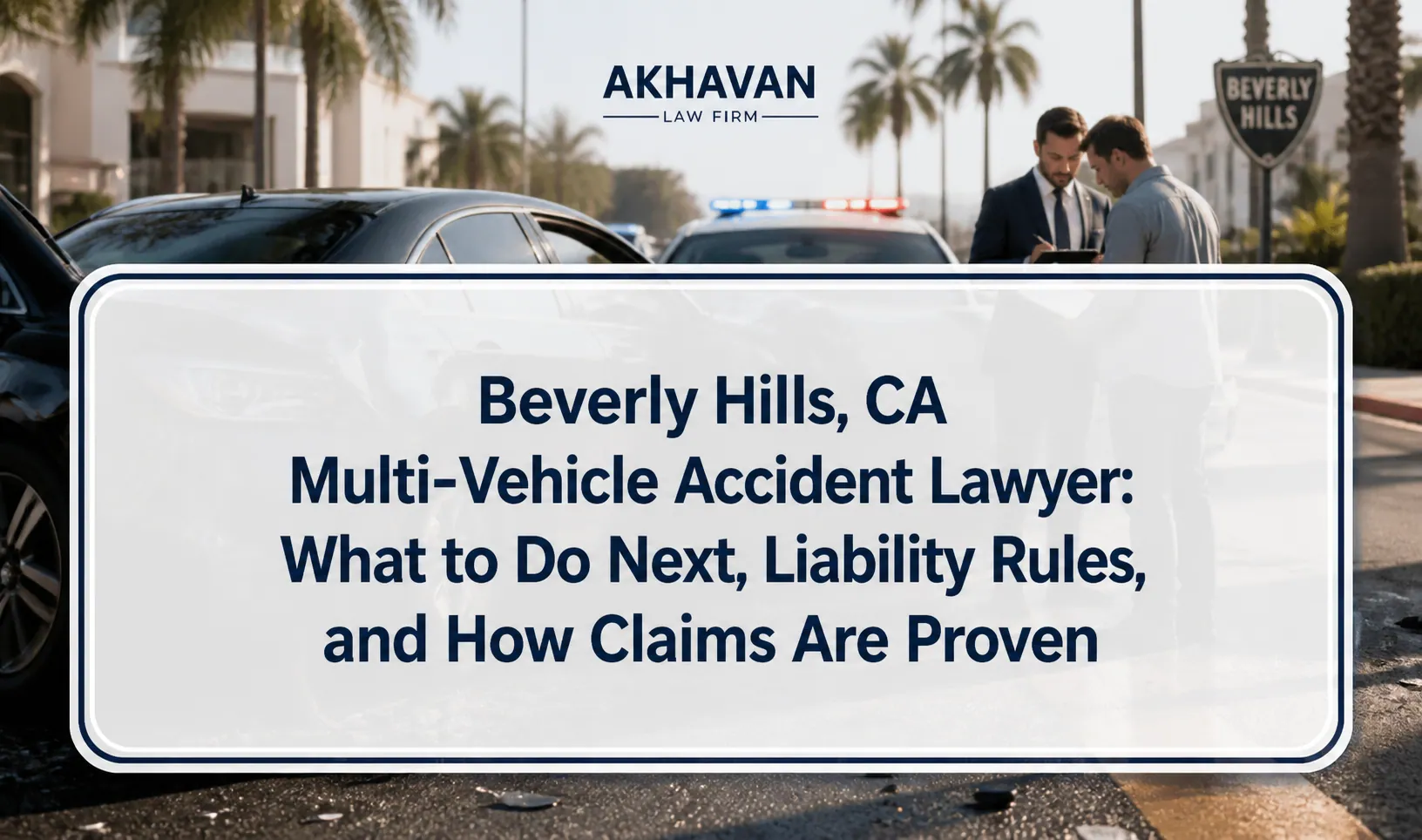
A Beverly Hills multi-vehicle accident case is a chain-reaction collision claim where fault, damages, and insurance coverage must be proven across multiple drivers and policies. A Beverly Hills Multi-Vehicle Accident Lawyer typically evaluates every impact, every lane position, and every timing interval to identify the first negligent act and any later contributing errors. On Santa Monica Boulevard near Wilshire, a rear driver can trigger a three-car pileup, while a middle driver may share fault for following too closely or stopping abruptly without a hazard. On La Cienega near the 10 ramps, a sudden lane change can create a sideswipe that pushes a vehicle into adjacent traffic, creating separate points of impact and separate injury mechanisms. Liability is usually analyzed under California comparative negligence, so fault can be split by percentages among multiple parties based on speed, following distance, distraction evidence, and roadway conditions. Claims are proven with technical documentation, including the Traffic Collision Report, body-worn camera footage if any, 911 CAD logs, photos showing crush patterns, EDR “black box” data on braking and speed, and time-stamped surveillance from nearby storefronts. Medical proof often requires linking each crash pulse to specific injuries, such as cervical strain, concussion, or exacerbation of prior back conditions, using ER records, imaging, and consistent treatment notes. Insurance issues are central, because several policies may apply, coverage limits can stack or conflict, and disputes can arise over who was the “primary” cause versus a later contributor. The next steps typically include preserving vehicles for inspection, obtaining witness contact details from each car, documenting scene geometry, and avoiding recorded statements that lock in an inaccurate sequence of events.
How Liability Is Determined in a Beverly Hills Chain-Reaction Collision
Multi-vehicle cases are decided by reconstructing the sequence of impacts and assigning fault under California’s pure comparative negligence rules. That means more than one driver can be responsible, and each percentage of fault directly affects what each insurer must pay.
In most pileups, the legal question is not “who hit whom,” but “which unsafe act started the cascade, and which later decisions made the damage worse.” A thorough analysis commonly focuses on:
- Following distance and speed in stop-and-go traffic (rear-end dynamics often implicate basic speed and safe distance principles).
- Lane-change timing (whether a driver moved when it was unsafe, forcing evasive braking or swerving).
- Driver distraction or impairment evidence (phone use, fatigue, alcohol/drug indicators).
- Roadway geometry (curves, ramp merges near the 10, signal timing, and lane widths common on major Beverly Hills corridors).
- Vehicle positioning at each impact point—because the “first impact” and “most harmful impact” are not always the same.
California uses pure comparative negligence, which allows recovery even if an injured person is mostly at fault, while reducing damages by that assigned percentage (Li v. Yellow Cab Co., 13 Cal.3d 804 (1975)). In a multi-car scenario, that principle often results in several partial settlements, cross-claims between insurers, or a global mediation where apportionment is negotiated with reconstruction evidence.
Key California Laws and Procedures That Control Multi-Car Claims
These cases turn on specific statutory deadlines, evidence rules, and insurance requirements. Missing a deadline or making an early statement without documentation can permanently weaken fault allocation.
Several California rules repeatedly control Beverly Hills pileup outcomes:
- Two-year injury statute of limitations: Personal injury lawsuits generally must be filed within 2 years of the crash date (California Code of Civil Procedure § 335.1).
- Government claim deadline when a public entity is involved: If the roadway design, signal timing, or a city vehicle is implicated, an administrative claim is typically due within 6 months (Gov. Code § 911.2), before any lawsuit.
- Comparative fault allocation: Juries can split fault among drivers and sometimes non-parties, affecting net recovery (Li v. Yellow Cab Co.).
- Minimum auto liability limits: Liability coverage is regulated by state financial responsibility laws, but real-world multi-car losses often exceed minimums, making UM/UIM and umbrella policies critical.
A Beverly Hills Multi-Vehicle Accident Lawyer typically structures the case around these rules from day one: preserve evidence, identify every potentially responsible party, and ensure the correct claims process is followed if any public entity involvement is suspected.
Evidence That Actually Moves the Needle in a Pileup Investigation
The most persuasive evidence is the kind that locks in timing, speed, and lane position. In multi-impact crashes, objective data often matters more than subjective recollections.
Because drivers in a chain-reaction collision commonly give conflicting versions, strong claims are built from time-stamped, measurable proof such as:
- Traffic Collision Report and any diagram/party statements recorded at the scene.
- 911 CAD logs showing call times, reported directions of travel, and early admissions (e.g., “I looked down,” “I didn’t see traffic stopped”).
- Body-worn camera footage (if a responding agency used it and it captures spontaneous statements or vehicle positioning).
- Surveillance video from storefronts, garages, hotels, and intersections—especially valuable on commercial corridors.
- Vehicle “black box” (EDR) downloads where available, capturing pre-crash speed, braking, throttle input, and delta-V on certain vehicles.
- Crush damage patterns and under-ride/over-ride indicators that help identify impact direction and force transmission.
- Cell phone records when distraction is disputed (handled via formal discovery or authorization, not speculation).
When evidence is at risk of being overwritten (video systems) or repaired away (vehicle damage), counsel often uses formal spoliation prevention steps—written preservation requests to drivers, insurers, towing yards, and repair facilities—to prevent loss of key proof.
Medical Causation in Multiple Impacts: Linking Each Crash Pulse to Each Injury
In a multi-vehicle collision, the defense often argues that injuries came from a “different impact” or were “pre-existing.” The legal solution is a clear timeline: symptoms, imaging, treatment, and medical opinion mapped to each mechanism of injury.
Common injury disputes in Beverly Hills pileup claims involve the difference between:
- Acute injury (new cervical strain/sprain, concussion, fracture) versus exacerbation of a degenerative condition.
- First hit vs. second hit causation (e.g., rear impact causing whiplash and a later lateral strike causing shoulder injury).
- Delayed symptom onset (common with concussions and soft-tissue injuries, but must be documented consistently).
Medical proof that tends to hold up under California litigation standards includes:
- ER/urgent care records documenting early complaints and objective findings.
- Imaging (X-ray, CT, MRI) tied to clinical exam findings.
- Consistent treatment notes showing symptom progression and functional limitations.
- Specialist evaluations (orthopedics, neurology, pain management) where indicated.
- Work status documentation supporting wage loss and restrictions.
In higher-exposure cases, attorneys may also use biomechanical/accident reconstruction experts to correlate delta-V, occupant kinematics, and seatbelt use with likely injury mechanisms, especially where insurers contest causation based solely on property damage photos.
Insurance Coverage: Why Multi-Policy Cases Get Complicated Fast
Multi-car crashes often involve overlapping liability policies, UM/UIM coverage, and disputes about priority of coverage. The practical goal is to assemble the full coverage stack and prevent insurers from shifting blame to reduce payout.
Coverage issues commonly arise when:
- Multiple drivers share fault and each carrier argues another driver was “more responsible.”
- Policy limits are insufficient compared with combined medical bills, wage loss, and future care.
- Uninsured or underinsured drivers are part of the chain reaction, triggering UM/UIM claims.
- Rideshare involvement creates tiered coverage disputes based on app status (offline, available, en route, passenger onboard).
- Commercial vehicles introduce higher limits, federal/state compliance questions, and corporate defendants.
When negotiating a global settlement, an effective approach is to document (1) the total damages, (2) the likely fault apportionment ranges, and (3) the available coverage by layer. If a claimant’s own UM/UIM coverage is in play, timing and consent-to-settle requirements can matter, so the sequence of settlements should be handled carefully.
Compensation Categories Typically Pursued After a Beverly Hills Pileup
Damages are not limited to medical bills; they include income loss, future care, and non-economic harm. The documentation must match each claimed category to admissible proof.
A well-built demand package usually itemizes:
- Past medical expenses (billed amounts and paid amounts, organized by provider and date of service).
- Future medical care supported by physician opinion and treatment projections (e.g., injections, surgery, rehab).
- Past lost earnings (pay stubs, tax returns, employer verification).
- Loss of earning capacity when injuries restrict long-term work ability (often supported by vocational and economic analysis).
- Property damage and towing/storage bills, plus rental car expenses when properly documented.
- General damages for pain, suffering, and loss of enjoyment of life (supported by treatment consistency and functional impact).
Where collision forces are disputed, keeping an organized paper trail becomes decisive. For practical guidance that aligns with how insurers evaluate early documentation, see after an auto accident, the steps you need to take.
Core Investigation Timeline: What to Do in the First 7–30 Days
The first month is when evidence disappears and narratives harden. A disciplined timeline preserves proof, reduces coverage disputes, and protects the accuracy of the crash sequence.
Recommended actions are typically:
- Request the Traffic Collision Report as soon as available and verify every listed driver, insurer, and diagram detail.
- Preserve vehicles until photos, measurements, and (if applicable) EDR downloads are completed.
- Identify all witnesses from each car, plus pedestrians, valets, security personnel, and nearby workers.
- Send preservation letters for video footage and EDR data to all involved parties and relevant businesses.
- Document injuries in real time with consistent medical follow-up, avoiding gaps that insurers label as “resolved.”
- Avoid recorded statements that lock in an incorrect sequence before reports/video/EDR are reviewed.
In Beverly Hills cases, early scene documentation matters because short blocks, heavy curbside parking, and frequent turning movements can materially affect the feasibility of avoidance maneuvers and line-of-sight.
Structured Snapshot: What Insurers and Attorneys Evaluate in Multi-Vehicle Claims
This table condenses the most decision-driving metrics into a single, insurer-readable framework. It also highlights local procedural considerations that frequently apply in Los Angeles County and Beverly Hills investigations.
| Feature / Metric | Specifications | Local Guidelines |
|---|---|---|
| Crash sequence proof | Traffic Collision Report, photos, surveillance, witness statements, vehicle rest positions | Request reports promptly; preserve nearby business video systems that may overwrite within days |
| EDR / telematics data | Pre-crash speed, braking, throttle, seatbelt use (vehicle-dependent) | Send preservation letters before vehicles are repaired or totaled; coordinate downloads with qualified experts |
| Fault allocation method | Pure comparative negligence; multiple drivers can share percentages | Li v. Yellow Cab Co. governs comparative fault in California; allocations drive settlement contributions |
| Filing deadlines | 2 years for most injury claims (CCP § 335.1); 6 months for many public-entity claims (Gov. Code § 911.2) | If road design/signals/municipal vehicles are involved, evaluate government claim requirements immediately |
| Medical causation support | ER notes, imaging, specialist reports, consistent treatment timeline | Link each injury to a mechanism (rear impact vs. side impact) to defeat “different crash” defenses |
| Coverage mapping | Multiple liability policies, UM/UIM, umbrella, commercial or rideshare layers | Obtain declarations pages; confirm priority and consent-to-settle issues before finalizing partial settlements |
When Multi-Vehicle Crashes Involve Commercial, Rideshare, or Transit Defendants
Commercial and app-based claims introduce additional records, higher insurance layers, and corporate defense strategies. The investigation expands beyond driver behavior to include hiring, training, maintenance, and dispatch/app status records.
Situations that require expanded evidence requests include:
- Rideshare vehicles: trip logs, app status, driver history, and tiered insurance coverage questions.
- Trucks and delivery vans: maintenance files, driver qualification records, route/dispatch data, and company safety policies.
- Public transit or shuttle involvement: potential government claim deadlines, operator training, and surveillance video retention requests.
If the collision involves app-based transportation, a targeted approach similar to an Uber/Lyft accident claim is often necessary, because the insurance layers and proof requirements differ from a standard two-car crash.
How Legal Representation Changes the Outcome in a Multi-Impact Case
The main value is coordinated liability and coverage proof across multiple drivers while protecting medical causation. Without that structure, claimants often get pressured into early low settlements before the true fault split and coverage stack are known.
A Beverly Hills Multi-Vehicle Accident Lawyer typically focuses on:
- Creating a single master timeline of impacts and vehicle positions using reports, video, and EDR where available.
- Preventing inconsistent statements by ensuring the sequence is verified before formal interviews.
- Forcing early disclosure of coverage with declarations pages and policy confirmations from each carrier.
- Building causation with organized medical records and, when needed, expert support.
- Negotiating multi-car resolutions through global mediation or structured settlement conferences when several insurers must contribute.
For readers who want context on what this role entails in the broader legal system, a personal injury lawyer is generally the attorney who investigates fault, proves damages, negotiates with insurers, and litigates when a fair settlement is not offered.
Clear Next Steps After a Beverly Hills Multi-Vehicle Crash
Winning these cases requires early preservation, disciplined medical documentation, and a verified crash sequence. The strongest claims are built like reconstructions, not arguments.
If you were hurt in a chain-reaction collision, prioritize actions that protect both liability and damages:
- Gather identifiers for every vehicle: driver names, plates, insurers, and passenger contacts from each car involved.
- Secure evidence fast: request nearby surveillance, keep all photos, and preserve the vehicle until it is documented.
- Get consistent medical care: follow-through matters as much as the first visit, especially with concussion and spine complaints.
- Track losses: maintain a folder for medical bills, mileage, wage loss, and repair/rental documents.
- Do not lock in a guess: avoid recorded statements about sequence and timing until the report and objective data are reviewed.
Handled correctly, multi-vehicle claims can be resolved by proving (1) the initiating negligent act, (2) each contributing error, (3) the full injury picture across impacts, and (4) the complete insurance coverage available to pay the loss.
Frequently Asked Questions
Don’t Let a Multi-Car Crash Turn Into a Multi-Company Runaround
Chain-reaction collisions in Beverly Hills aren’t “bigger fender benders”—they’re liability puzzles where every driver and every insurer has a financial reason to pin the sequence on someone else. If you try to handle it alone, you can accidentally hand them exactly what they need: an off-the-cuff timeline, a recorded statement, or a missing piece of proof that quietly shifts fault onto you.
Here’s what tends to go wrong without an experienced local lawyer managing the case from day one:
- Fault gets “assigned” before the evidence is collected—video overwrites, vehicles get repaired or totaled, and the story hardens around whoever spoke first.
- Insurers split the claim into fragments—each carrier pays as little as possible, blames another driver, and delays until pressure forces a low settlement.
- Comparative negligence reduces your recovery—even a small percentage shift can cost serious money, especially when multiple policies and limits are involved.
- Medical causation gets attacked—they argue “wrong impact,” “pre-existing,” or “too little damage,” and your injuries get discounted unless the timeline is documented correctly.
- Coverage is missed or mishandled—UM/UIM, rideshare tiers, commercial layers, umbrella policies, and consent-to-settle traps can shrink what’s actually available to pay your claim.
A focused multi-vehicle case strategy is simple in concept but demanding in execution: lock down the crash sequence with objective proof, preserve what disappears first, map every policy that can pay, and build medical documentation that survives the “different impact” defense. Done right, you stop guessing—and you start proving.
Disclaimer: The information provided on this page is for general informational purposes only and should not be considered legal advice. Reading this page, using this website, or contacting us through this page does not create an attorney-client relationship. Every legal matter is different, and the information here may not apply to your specific situation. You should not act or rely on any information on this page without first consulting a qualified attorney about your individual case.

Edwin E. Akhavan is the founding attorney of Akhavan Law Firm APC, a personal injury law firm in Beverly Hills, California. State Bar of California #270338. About the firm