On this page
- Key Takeaways
- How fault is determined in a Beverly Hills DUI crash
- What evidence strengthens a drunk driving injury claim
- Compensation that may be available after a DUI crash
- Insurance issues unique to drunk driving collisions
- Medical treatment and documentation: building a clean injury record
- Deadlines and procedural considerations in California
- How a Drunk Driving Accident Attorney Beverly Hills may build your case
- Quick reference: DUI crash claim components and what they require
- What to do next after a suspected drunk driving crash
- Choosing legal help: what to look for in a DUI injury case
- Moving forward with clarity after a Beverly Hills DUI collision
- Frequently Asked Questions
- Talk with a Beverly Hills DUI Crash Attorney About Your Next Steps
Key Takeaways
A drunk-driving injury claim in Beverly Hills still requires proving negligence, causation, and damages—not just pointing to a DUI arrest—so early, organized evidence preservation and medical documentation are critical. Because insurers may dispute fault, minimize injuries, or push recorded statements and quick releases, careful communication and complete records can materially affect what can be recovered.
- Fault requires more than a DUI arrest: Civil liability turns on showing the driver’s negligent conduct caused the crash and your injuries, and California’s pure comparative fault rules can reduce compensation if insurers successfully argue shared responsibility.
- Time-sensitive evidence can decide the claim: High-value proof includes the police report, witness contacts, and time-stamped third-party video, but surveillance footage and vehicle evidence can be lost quickly if vehicles are repaired or footage is overwritten.
- Damages must be proven with consistent records: Compensation may include medical expenses, lost income, vehicle damage, and pain and suffering (and punitive damages may be pursued in some cases but are not automatic), and insurers often discount claims with gaps in care or unclear wage and treatment documentation.
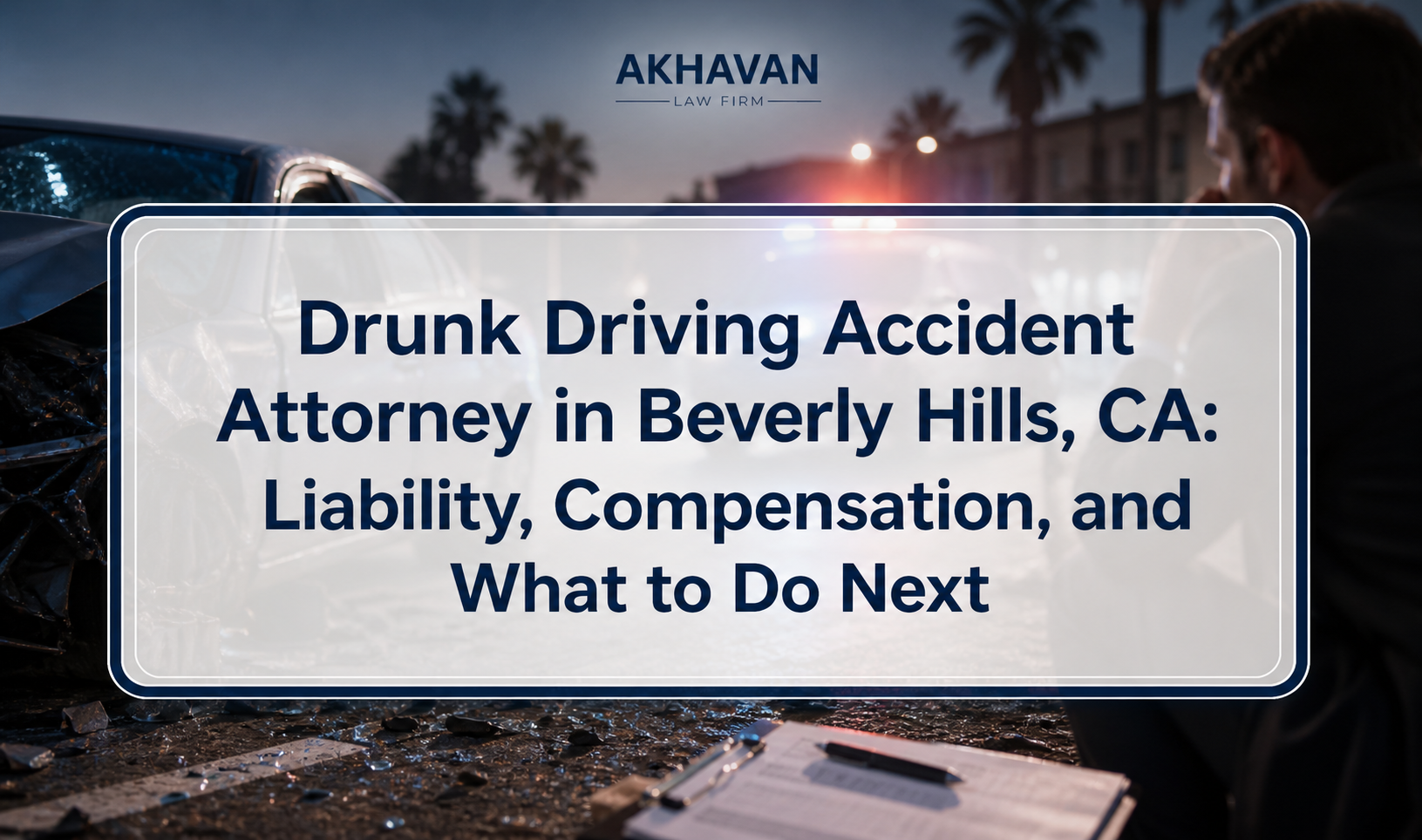
A drunk driving accident attorney Beverly Hills can help you evaluate liability, preserve evidence, and pursue compensation after a DUI crash in or around Beverly Hills, California. Because alcohol-impaired driving cases often involve parallel criminal and insurance issues, early legal guidance can be important to protect your rights and avoid missteps with adjusters or recorded statements.
In California, potential financial recovery may include medical expenses, lost income, vehicle damage, and pain and suffering, but the value and viability of a claim depend on proof. Key evidence can include the police report, DUI arrest or chemical test information when available through proper channels, witness statements, traffic or security video, and documentation of treatment and wages.
This guide explains how fault is determined, what compensation may be available, and what to do next—from getting medical care and reporting the crash to deadlines, insurance communications, and steps an attorney may take to build a strong injury claim.
How fault is determined in a Beverly Hills DUI crash
Fault in a drunk-driving injury case is based on negligence—whether the impaired driver (or another party) failed to use reasonable care and that failure caused harm. DUI evidence can be powerful, but it is not the only way to prove liability.
In Beverly Hills and surrounding areas (including West Hollywood, Century City, and along major corridors like Santa Monica Blvd. and Wilshire Blvd.), investigators and insurers typically look at a combination of driving behavior, roadway conditions, and objective proof of impairment. Even when an intoxicated driver is arrested, the civil case still requires connecting their conduct to the collision and your damages.
Negligence vs. DUI: what matters in a civil claim
A DUI arrest can support your claim, but civil liability still turns on whether the driver’s conduct caused the crash and your injuries. Your attorney will usually build the case around multiple, cross-checking sources of proof.
Common DUI-related negligence issues include unsafe speed, lane deviations, failure to yield, following too closely, and delayed reaction time. If the other driver denies drinking—or claims you caused the crash—civil evidence like scene measurements, photos, and third-party video can become decisive.
- Negligence: failure to drive with reasonable care under the circumstances.
- Causation: proof the negligence caused the collision and injuries.
- Damages: documentation of medical costs, wage loss, and other harms.
Comparative fault in California
California follows a “pure comparative fault” approach, meaning fault can be shared and compensation is typically reduced by your percentage of responsibility. This is especially important when insurers argue distraction, speed, or late braking by the injured person.
Even if the other driver was intoxicated, insurers may still scrutinize seatbelt use, point of impact, and whether you had time to avoid the crash. A Drunk Driving Accident Attorney Beverly Hills will often focus on objective evidence to minimize unfair fault allocation.
- Vehicle damage patterns and crush profiles
- Skid marks, debris fields, and final rest positions
- 911 calls and time-stamped video
- Phone records (when relevant and obtainable through proper legal process)
What evidence strengthens a drunk driving injury claim
The strongest DUI injury claims are built early, before vehicles are repaired and footage is overwritten. The goal is to preserve independent evidence that confirms impairment, fault, and the extent of injuries.
Alcohol-impaired crashes often involve multiple parallel tracks—criminal prosecution, DMV consequences, and insurance claims—so evidence can be scattered across agencies and private sources. An attorney can help coordinate lawful access to records and make sure key materials are preserved through letters and formal requests.
High-value evidence in DUI crash cases
Evidence is most persuasive when it is time-stamped, third-party, and consistent across sources. Your documentation (symptoms, treatment, missed work) is also critical because damages must be proven—not assumed.
- Police traffic collision report (includes party statements, diagram, and citations when issued)
- DUI-related records (arrest report, chemical test details, booking information—when available through proper channels)
- Witness statements (names and contact info are often more valuable than informal summaries)
- Video from nearby businesses, residences, parking garages, or dashcams
- Photos of vehicle positions, damage, roadway conditions, and injuries
- Medical records and itemized billing (ER, urgent care, imaging, specialists, PT)
- Wage documentation (pay stubs, time-off records, employer confirmation)
If you need help understanding what the report says (and what it doesn’t), the guide on how to read a California accident police report explains common sections and how insurers use them.
Preservation steps that matter in Beverly Hills
Many valuable sources—like security video—may be deleted in days or weeks, so preservation requests should be sent quickly. When possible, you should also keep your own timeline and documents organized from the start.
- Photograph your vehicle before repairs and keep repair estimates.
- Write down symptoms each day, especially sleep disruption, headaches, dizziness, and limitations.
- Save receipts for out-of-pocket expenses (medications, rides, medical devices).
- Identify nearby cameras (retail entrances, valet stands, parking structures) and note addresses.
- Avoid discussing fault in texts or social posts that may be taken out of context.
Compensation that may be available after a DUI crash
Financial recovery in a drunk-driving injury case generally depends on provable losses tied to the collision. Most claims focus on economic damages (bills and wage loss) and non-economic damages (pain, suffering, and life impact).
The value of a case varies widely based on injury severity, treatment course, gaps in care, and available insurance. A Drunk Driving Accident Attorney Beverly Hills can help identify all compensable categories and present them clearly to insurers or a jury.
Economic damages (financial losses)
Economic damages are typically calculated from records: medical bills, wage statements, and repair estimates. Keeping organized documentation can prevent underpayment based on “missing proof.”
- Emergency care, imaging, surgery, medications, physical therapy
- Future medical needs supported by treating-provider opinions
- Lost wages and reduced earning capacity (when supported by records)
- Vehicle repair or total-loss value and related expenses (towing, storage)
- Out-of-pocket costs such as transportation to appointments
Non-economic damages (human losses)
Non-economic damages address the ways an injury changes your life, even when there is no invoice. Insurers often undervalue these losses unless they are documented with consistent treatment and credible descriptions.
- Pain, discomfort, and physical limitations
- Emotional distress, anxiety, sleep issues, trauma symptoms
- Loss of enjoyment of activities and hobbies
- Impact on relationships and daily functioning
Punitive damages: possible, but not automatic
In some drunk driving cases, punitive damages may be pursued if the evidence supports punishment-level misconduct under California standards. Whether they apply depends on the facts, available proof, and how the case is pleaded and litigated.
Because punitive damages have special legal requirements and are often contested aggressively, it is important to treat them as a possibility—not a guarantee—and to focus first on proving liability and compensatory damages thoroughly.
Insurance issues unique to drunk driving collisions
DUI crashes often trigger aggressive insurance tactics, including quick settlement offers and requests for recorded statements. What you say early can materially affect disputed liability, injury causation, and claimed damages.
It is common for the at-fault driver’s insurer to seek broad medical authorizations or minimize injuries as “pre-existing.” Careful, guided communication can help avoid accidental concessions.
Recorded statements and early settlement offers
You are not always required to provide a recorded statement to the other driver’s insurer, and doing so without advice can create avoidable risk. Early offers may also come before the full injury picture is known.
- Statements can lock you into details you later learn are incomplete (like delayed symptoms).
- Adjusters may ask leading questions to suggest shared fault.
- Signing a release ends your claim even if complications appear later.
For a deeper look at how settlement negotiations usually unfold, see how car accident cases are settled.
Uninsured/underinsured motorist considerations
If the drunk driver has low limits or no insurance, your own policy’s uninsured/underinsured motorist coverage (UM/UIM) may be relevant. These claims have strict notice and procedural requirements, and the documentation burden can be significant.
Even when coverage exists, insurers often dispute the extent of injuries or argue treatment was excessive. A well-supported medical narrative and consistent records often matter as much as the collision evidence.
Medical treatment and documentation: building a clean injury record
Medical care protects your health and creates the records that connect the crash to your injuries. Delayed or inconsistent treatment is one of the most common reasons insurers discount a claim.
Some injuries—particularly concussions, whiplash-related soft tissue injuries, and certain back injuries—may worsen over days. Prompt evaluation helps rule out serious issues and reduces arguments that symptoms are unrelated.
Practical tips for treatment documentation
Good documentation is not about exaggeration—it is about clarity and consistency. If you feel fine initially but develop symptoms later, report them promptly and accurately.
- Attend follow-up visits and comply with treatment plans when possible.
- Tell providers how the injury affects work and daily activities (lifting, driving, sleep).
- Keep a list of symptoms and bring it to appointments.
- Ask for work restrictions in writing if you need them.
- Save discharge instructions, imaging results, and referral paperwork.
Deadlines and procedural considerations in California
Time limits can affect your ability to recover compensation, so it is important to identify the right deadline early. The applicable statute of limitations depends on the type of claim and parties involved.
For example, if a public entity is involved (such as a government vehicle or roadway defect claim), special notice requirements and shorter timelines may apply. Because these rules are fact-specific, prompt legal review is often valuable.
How a Drunk Driving Accident Attorney Beverly Hills may build your case
Most DUI injury claims require more than showing the other driver was arrested; they require a complete, organized proof package that can withstand insurer scrutiny. Legal representation typically focuses on investigation, documentation, negotiation, and—if necessary—litigation.
Because impaired-driving crashes can cause severe injuries, attorneys often also assess long-term medical needs, wage impact, and whether additional liable parties exist.
Case-building steps commonly taken
While every case is different, a structured approach can prevent evidence loss and strengthen leverage during negotiations. Some steps may occur simultaneously depending on urgency.
- Obtain collision report(s), photos, and available video sources.
- Identify and interview witnesses while memories are fresh.
- Preserve vehicle evidence and review repair/total-loss documentation.
- Track medical treatment and request complete records and billing.
- Analyze insurance coverages (liability, UM/UIM, med pay) and exclusions.
- Prepare a demand package summarizing liability and damages.
- Negotiate, and file suit if the insurer disputes responsibility or undervalues harm.
When the crash involves rideshare, pedestrians, or commercial vehicles
Liability and insurance can become more complex when the drunk driver was working, driving a company vehicle, or involved in a rideshare. Different policies may apply, and evidence like app status or employer scope-of-employment may matter.
- If the DUI driver was in an Uber/Lyft context, coverage can depend on ride status and policy layers.
- If a pedestrian was hit, impact speed, visibility, and crosswalk signals may become central issues.
- If a commercial vehicle is involved, additional regulatory and documentation issues may exist.
For crashes that involve app-based transportation, you can learn more about Uber/Lyft accident claims and how insurance questions can differ from ordinary collisions.
Quick reference: DUI crash claim components and what they require
This table summarizes key parts of a DUI injury claim and the types of proof that commonly support each. It’s a practical checklist for organizing information with your attorney.
| Claim Component | Typical Proof Used | Beverly Hills / LA Area Practical Notes |
|---|---|---|
| Liability (who caused the crash) | Police report, witness statements, photos, video, scene measurements | Nearby business/security footage can be overwritten quickly; early preservation requests are often important. |
| Impairment evidence (supporting DUI-related negligence) | Officer observations, field sobriety notes, chemical test info when obtainable, 911 calls | Criminal/DMV records may not be immediately accessible to victims; an attorney can pursue lawful channels and subpoenas if litigation is filed. |
| Medical causation (injuries linked to crash) | ER/urgent care notes, imaging, specialist opinions, PT records, symptom timeline | Gaps in care can be used by insurers to argue symptoms are unrelated; consistent follow-up helps clarify causation. |
| Lost income and work impact | Pay stubs, tax forms, employer letters, disability notes, schedule records | For self-employed claimants, invoices, contracts, and business records often carry more weight than estimates. |
| Pain and suffering (non-economic damages) | Treatment notes, consistent reports of limitations, journals, corroborating statements | Clear examples (missed activities, interrupted sleep, childcare limitations) help translate impact into understandable terms. |
What to do next after a suspected drunk driving crash
After immediate safety and medical needs, the next steps are about protecting evidence and avoiding insurance pitfalls. Acting promptly can make a measurable difference in what can be proven later.
- Get medical evaluation the same day when possible, especially for head, neck, or back symptoms.
- Report the collision and request the report number; ask how to obtain the final report.
- Photograph damage and the scene from multiple angles; capture street signs and signal placement.
- Collect witness contact information before people leave.
- Notify your insurer (basic notice), but be cautious with detailed recorded statements until you understand your situation.
- Keep all treatment and wage records in one folder (digital or physical).
If you want a step-by-step checklist that applies to most crashes, the resource on the steps you need to take after an auto accident can help you stay organized during the first days and weeks.
Choosing legal help: what to look for in a DUI injury case
The right fit is usually an attorney who can investigate quickly, handle insurance pressure, and document damages in a way that holds up if the case becomes contested. DUI cases also benefit from lawyers who understand how criminal case facts can (and cannot) be used in civil litigation.
When evaluating a Drunk Driving Accident Attorney Beverly Hills, consider asking detailed process questions—not just outcome questions—because strong results generally come from thorough early work and clear documentation.
- How will you preserve video and vehicle evidence?
- Who will handle insurer communications and medical record collection?
- How do you evaluate future medical needs or long-term work impact?
- What happens if the insurer disputes fault or claims comparative negligence?
For general background on the role and responsibilities of this type of counsel, you can review the overview of a personal injury lawyer.
Moving forward with clarity after a Beverly Hills DUI collision
A DUI crash can leave you juggling medical care, vehicle issues, missed work, and aggressive insurance calls—often while you’re still in pain. The most effective path forward is usually to focus on health first, then preserve evidence and document losses so your claim can be evaluated on facts rather than assumptions.
Whether your case resolves through insurance negotiations or requires litigation, careful early decisions can reduce disputes later. If you suspect alcohol impairment played a role, timely investigation and organized records can be the difference between a disputed claim and a well-supported demand for full compensation.
Frequently Asked Questions
Talk with a Beverly Hills DUI Crash Attorney About Your Next Steps
If you were hurt in a suspected drunk driving collision, getting clear guidance early can help you protect evidence, avoid avoidable insurance pitfalls, and understand what information actually supports a strong injury claim. Video can be overwritten, vehicles repaired, and details forgotten—so having a plan for documentation and lawful record requests matters.
Akhavan Law Firm can help you evaluate liability, organize medical and wage proof, and handle communications so your claim is presented accurately and consistently—especially if comparative fault is being suggested or coverage questions come up.
Disclaimer: The information provided on this page is for general informational purposes only and should not be considered legal advice. Reading this page, using this website, or contacting us through this page does not create an attorney-client relationship. Every legal matter is different, and the information here may not apply to your specific situation. You should not act or rely on any information on this page without first consulting a qualified attorney about your individual case.

Edwin E. Akhavan is the founding attorney of Akhavan Law Firm APC, a personal injury law firm in Beverly Hills, California. State Bar of California #270338. About the firm