On this page
- Executive Summary
- Core Insights
- What a Neck-Injury Attorney Does in a Beverly Hills Case
- Neck Injuries Commonly Claimed After Collisions and Falls
- How Liability Is Proven Under California Negligence Rules
- Local Evidence That Strengthens Neck-Injury Claims in Beverly Hills
- Medical Documentation: What Adjusters and Juries Treat as “Objective”
- Compensation Categories Available in California Neck-Injury Claims
- Key Deadlines and Procedural Rules That Can Control the Outcome
- What to Do After a Crash or Fall to Protect a Neck-Injury Claim
- How Neck-Injury Claims Are Evaluated and Negotiated by Insurance Carriers
- Core Case Metrics Table (Medical, Liability, and Local Procedure)
- When to Consider Filing a Lawsuit Instead of Waiting on Settlement
- Related Injury Matters Often Packaged With Cervical Claims
- Choosing the Right Case Path for a Beverly Hills Injury Claim
- Clear Next Steps to Protect Your Neck Injury and Your Claim
- Frequently Asked Questions
- Don’t Let an Insurance Adjuster Turn Your Neck Injury Into “Just Soreness”
Executive Summary
A Beverly Hills neck injury lawyer builds a successful claim by proving liability with third-party crash or premises evidence and proving medical causation and damages through objective, consistent treatment records. The strongest outcomes come from early evidence preservation, prompt medical evaluation, and a demand strategy that addresses common insurance defenses before they control the narrative.
Core Insights
- Proof Chain Wins Cases: Neck injury claims are valued highest when the file clearly links the incident to symptoms, treatment, objective findings (like MRI/specialist exams), and real-world functional limits.
- Liability Must Be Built, Not Assumed: Police reports, neutral witnesses (including valet or retail staff), photos/video, and data evidence (dashcams, rideshare records, phone records) are often what turns a disputed case into a provable breach of duty.
- Deadlines and Early Steps Control Leverage: Fast medical documentation and evidence preservation improve settlement leverage, while missing the 2-year statute (or the 6-month government claim deadline when applicable) can reduce or eliminate recovery.
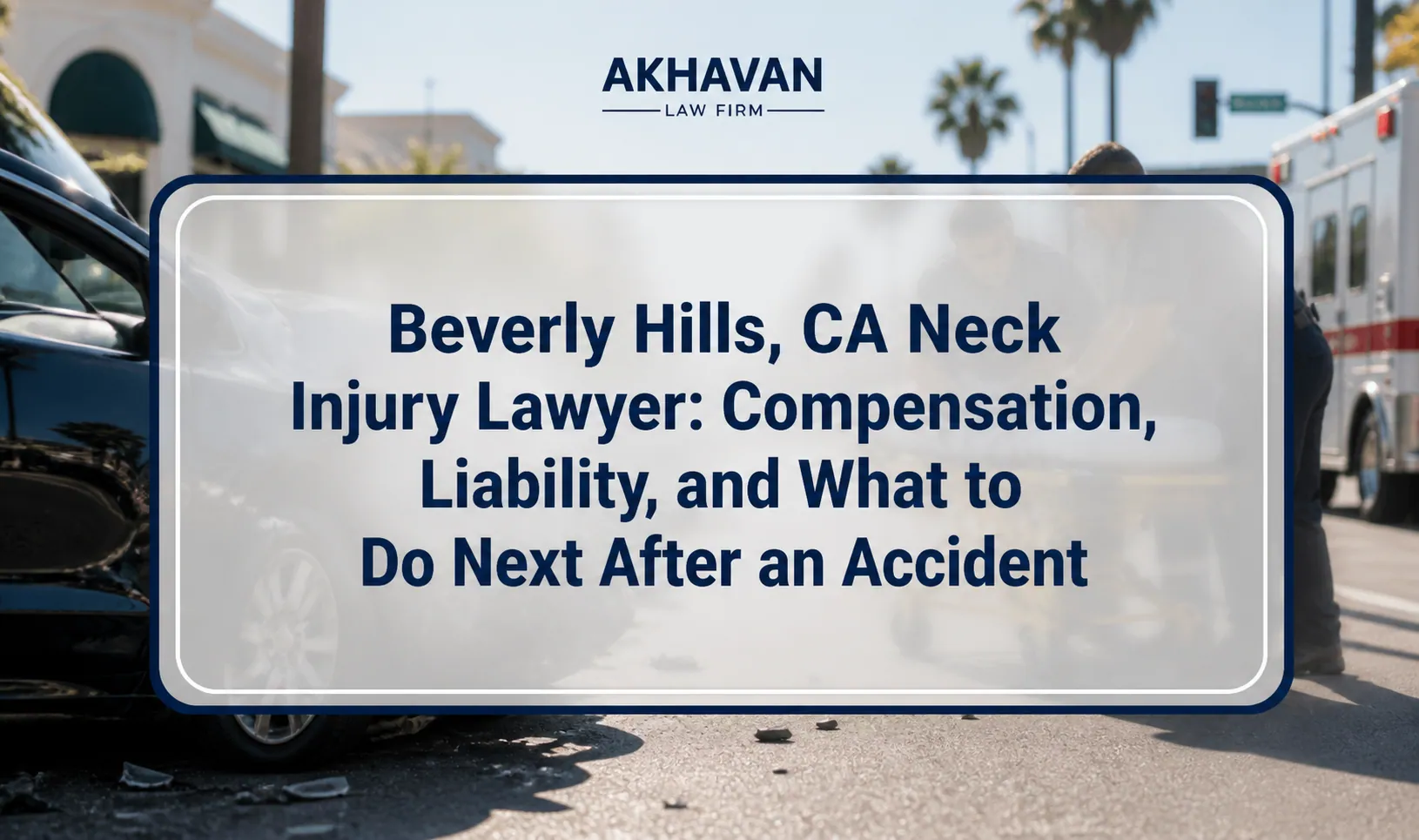
A Beverly Hills neck injury lawyer helps injured people pursue money damages after a crash or fall by proving liability, documenting medical harm, and negotiating or litigating an insurance claim. In Beverly Hills, common neck-injury events include rear-end collisions on Santa Monica Blvd near Wilshire Blvd, side-impact crashes on Sunset Blvd, rideshare drop-off collisions in the Golden Triangle, and slip-and-fall incidents on polished stone floors in high-traffic retail corridors like Rodeo Drive. Neck injuries often involve cervical strain, whiplash, herniated discs at C5–C6 or C6–C7, radiculopathy with arm numbness, and post-traumatic headaches. Strong claims use objective proof. Examples include EMS run sheets, ER imaging orders, MRI findings showing disc protrusion, orthopedic or neurology exams, physical therapy progress notes, and work-status restrictions for jobs that require prolonged driving or desk posture. Liability is typically built with collision-scene evidence. Examples include CHP traffic collision reports, Beverly Hills Police Department incident documentation, witness statements from nearby valet stands, skid-mark and vehicle-crush analysis, dashcam footage from adjacent vehicles, and phone-record subpoenas in distracted-driving cases. Compensation may include past and future medical bills, missed wages, reduced earning capacity, mileage to treatment, and non-economic damages for pain, sleep disruption, and loss of normal activities like gym training or childcare. The next steps are time-sensitive. Seek prompt medical evaluation, photograph vehicle damage and visible bruising, preserve helmet or seatbelt evidence, avoid recorded statements to insurers without counsel, and track symptoms daily to connect treatment to the mechanism of injury.
What a Neck-Injury Attorney Does in a Beverly Hills Case
A neck-injury claim succeeds when your lawyer connects the mechanism of injury to objective medical findings and a provable breach of duty. The work is evidence-driven: building liability, documenting damages, and positioning the claim for settlement or trial under California procedure.
In practice, representation typically includes:
- Liability development using police reports, witness statements, photos, video, vehicle damage documentation, and (when needed) accident reconstruction.
- Medical proof building through ER records, imaging (X-ray/CT/MRI), specialist exams, physical therapy notes, and functional limitations (work restrictions and activity limits).
- Insurance claim strategy by presenting a demand package, responding to adjuster defenses, and preparing you for compliant but safe claim communications.
- Litigation readiness if the carrier disputes fault or the value of cervical injuries, including discovery, expert retention, and trial exhibit preparation.
Neck Injuries Commonly Claimed After Collisions and Falls
Most compensable neck injuries involve the cervical spine, related soft tissue, and nerve structures, and they are evaluated through standard clinical exams plus imaging when clinically indicated. The key is not the label (like “whiplash”) but whether the medical record shows consistent complaints, objective findings, and functional impairment.
Neck-related diagnoses frequently seen after Beverly Hills crashes and premises incidents include:
- Cervical sprain/strain (whiplash-associated disorder) documented by reduced range of motion, muscle spasm, and pain with palpation.
- Disc bulge/protrusion or herniation often reported at C5–C6 and C6–C7, typically confirmed on MRI when symptoms persist or neurological signs appear.
- Cervical radiculopathy with radiating arm pain, numbness/tingling, or weakness supported by neurological exam findings; sometimes correlated with MRI and, when ordered by a physician, EMG/NCS.
- Post-traumatic headaches where providers document temporal relationship to the crash and cervical involvement.
- Facet-mediated pain identified clinically and sometimes treated with interventional pain procedures when conservative care fails.
How Liability Is Proven Under California Negligence Rules
California injury cases are built on four required elements: duty, breach, causation, and damages. Your claim value depends on proving each element with admissible evidence and medical documentation rather than personal belief.
A typical liability roadmap looks like this:
- Duty: Drivers must use reasonable care under the circumstances; property owners must maintain reasonably safe premises and warn of known or reasonably discoverable hazards.
- Breach: A specific act or omission (unsafe following distance, unsafe lane change, failure to clean/warn, etc.).
- Causation: The breach must be a substantial factor in causing the neck injury (linking crash dynamics or fall mechanics to symptoms and imaging).
- Damages: Medical bills, wage loss, and non-economic harm supported by records and credible testimony.
California also applies pure comparative fault, meaning an injured person can still recover damages even if partially responsible—though the recovery is reduced by their percentage of fault.
Local Evidence That Strengthens Neck-Injury Claims in Beverly Hills
Stronger claims use time-stamped, third-party, and medical evidence gathered early, because neck pain is often minimized by insurers as “subjective.” The most persuasive files show a clean chain: incident → symptoms → treatment → objective findings → functional limits.
Common evidence sources in Beverly Hills-area incidents include:
- Law enforcement documentation: Traffic collision reports and incident reports generated by responding agencies (and any diagram or narrative describing impact points).
- Scene and vehicle evidence: Photos of damage, interior contact points, seat position, headrest position, deployed airbags, and property defects (spill, uneven surface, missing warning signage).
- Video footage: Dashcams; nearby vehicle cameras; commercial surveillance where available; and time-stamped rideshare trip data in app-based collisions.
- Witness statements: Particularly neutral observers such as valet staff, pedestrians, nearby employees, or other motorists.
- Phone and data evidence: When appropriate, preservation letters and subpoenas for distracted driving proof (handled through counsel to fit civil discovery rules).
Medical Documentation: What Adjusters and Juries Treat as “Objective”
Objective proof is documentation created in the ordinary course of medical care that supports both diagnosis and functional impact. The goal is consistent, medically grounded records—especially important for cervical disc and nerve cases.
Records that often carry the most weight include:
- EMS run sheets noting pain complaints, cervical collar use, and mechanism of injury.
- ER/urgent care records with physical exam findings, imaging orders, and differential diagnosis.
- Radiology reports (X-ray/CT/MRI) describing disc pathology, stenosis, or foraminal narrowing when present.
- Orthopedic, neurology, or spine specialist exams documenting Spurling’s test, reflex changes, sensory deficits, or strength loss.
- Physical therapy notes tracking measured range-of-motion changes, functional tolerances, and response to care.
- Work-status and restrictions from a treating provider (limits on lifting, prolonged sitting/driving, overhead work, or screen posture).
Compensation Categories Available in California Neck-Injury Claims
Recoverable damages generally fall into economic losses (bills and wages) and non-economic losses (pain and life impact). A complete case file accounts for both, using documents rather than estimates.
Damages commonly pursued include:
- Medical expenses: ER care, imaging, specialist visits, PT, medications, and interventional procedures; future care when supported by treating physician opinion and medical necessity.
- Lost income: Pay stubs, W-2/1099 records, and employer verification for missed work; for self-employed claimants, business records may be necessary.
- Loss of earning capacity: When restrictions or chronic symptoms impair the ability to perform prior job duties.
- Out-of-pocket costs: Mileage to treatment and other medically related expenses tracked contemporaneously.
- Non-economic damages: Pain, sleep disruption, reduced mobility, loss of normal activities (exercise, childcare, travel), and the day-to-day burden of treatment.
Neck injuries can also trigger disputes about “pre-existing” degenerative findings. California practice focuses on whether the incident aggravated or accelerated symptoms and limitations, which is why baseline history and post-incident progression matter.
Key Deadlines and Procedural Rules That Can Control the Outcome
Time limits are not flexible once they expire, and evidence quality declines quickly after a crash or fall. A viable case plan addresses both the statute of limitations and early preservation steps.
California deadlines commonly implicated include:
- Personal injury statute of limitations: Generally 2 years from the date of injury under California Code of Civil Procedure section 335.1.
- Government claims: If a city, county, or other public entity is involved (for example, a dangerous condition on public property), a Government Code claim is typically required within 6 months of the incident under Government Code section 911.2.
Because neck injuries may worsen over days, early medical evaluation is also a procedural advantage: it creates near-contemporaneous records that connect symptoms to the incident.
What to Do After a Crash or Fall to Protect a Neck-Injury Claim
The best immediate steps are medical, documentation-based, and designed to prevent insurers from reframing the injury as unrelated or minor. These actions also preserve the factual “story” your records will later need to tell.
Use this checklist:
- Get evaluated promptly (ER/urgent care or your physician) and describe symptoms precisely: neck stiffness, range limits, radiating arm symptoms, headaches, dizziness.
- Photograph vehicle damage, seatbelt marks, bruising, and the surrounding scene (including traffic controls, lighting, or property hazards).
- Preserve evidence such as a damaged helmet, torn clothing, or the specific shoes worn in a slip-and-fall.
- Keep a symptom log with daily functional limits (sleep, driving tolerance, desk work, lifting, childcare tasks).
- Avoid recorded statements to an opposing insurer without legal advice; early statements are commonly used to dispute symptom onset or severity.
If you want a practical, step-by-step walkthrough that aligns with how claims are actually evaluated, review the steps you need to take after an auto accident.
How Neck-Injury Claims Are Evaluated and Negotiated by Insurance Carriers
Insurers focus on causation, consistency of treatment, and whether diagnostics support the claimed severity. Negotiation improves when your demand ties each dollar figure to a record and addresses defenses before the adjuster raises them.
Frequent adjuster arguments—and what counters them—include:
- “Minimal impact” defense: Counter with photos, repair documentation, impact direction, and medical onset timeline; vehicle appearance alone does not medically rule out injury.
- Gaps in treatment: Counter with documented reasons (delayed appointments, imaging authorization delays, work constraints) and consistent symptom reporting.
- Pre-existing degeneration: Counter with prior asymptomatic status (if true), new radicular signs, new functional restrictions, and provider opinions about aggravation.
- “Soft tissue only” minimization: Counter with measured ROM deficits, spasm findings, PT progress metrics, and specialist exams; if MRI supports disc pathology, highlight correlation to symptoms.
A helpful reference point for how a rear-end case can be analyzed at high value when the evidence supports it is this rear-end auto accident jury award example.
Core Case Metrics Table (Medical, Liability, and Local Procedure)
This table summarizes the claim elements that most directly affect a cervical injury case’s strength. It also flags local procedural realities that commonly appear in Beverly Hills-area incidents.
| Feature / Metric | Specifications | Local Guidelines |
|---|---|---|
| Statute of limitations (injury) | 2 years from date of injury (CCP § 335.1) | Calendaring is critical when treatment is ongoing and liability is disputed |
| Government claim deadline | Typically 6 months (Gov. Code § 911.2) before suing a public entity | Relevant when a dangerous condition exists on public property or a public vehicle is involved |
| Objective medical support | ER records, imaging orders, MRI reports, neuro/ortho exams, PT metrics | Prompt evaluation improves causation clarity and reduces “delayed onset” disputes |
| Liability proof | Police report, photos, video, witnesses, vehicle damage analysis | High-traffic corridors and valet zones increase the value of neutral witness and camera footage |
| Damages documentation | Itemized bills, wage proof, work restrictions, mileage log, activity limitations | Desk-work and driving limitations should be documented due to common Beverly Hills commuting patterns |
When to Consider Filing a Lawsuit Instead of Waiting on Settlement
Litigation becomes the rational next step when liability is denied, policy limits are inadequate, or the insurer refuses to value documented cervical injury appropriately. Filing suit also enables subpoenas, depositions, and expert discovery that can unlock key proof.
Situations that often justify filing include:
- Disputed fault (lane-change conflicts, intersection impacts, contested slip-and-fall notice issues).
- Uninsured/underinsured motorist complications requiring careful compliance with policy conditions.
- Disc injury with radiculopathy where the carrier insists it is “degenerative” despite consistent post-incident findings.
- High damages with low offers where medical bills and wage loss are well-supported but undervalued.
For a broader overview of how the profession functions in these cases, see personal injury lawyer.
Related Injury Matters Often Packaged With Cervical Claims
Neck injuries rarely occur in isolation, and related diagnoses can change the medical and settlement trajectory. Identifying co-injuries early helps avoid fragmented care and incomplete demands.
Commonly associated injuries include:
- Shoulder injuries (rotator cuff strain/tear symptoms sometimes overlap with cervical radiculopathy).
- Thoracic outlet-type symptoms requiring careful differential diagnosis by treating providers.
- Concussion or mild traumatic brain injury where headaches, dizziness, and concentration issues persist beyond expected timelines.
- Low back injury that increases overall impairment and complicates return-to-work restrictions.
Choosing the Right Case Path for a Beverly Hills Injury Claim
Case strategy should match the incident type: car crash, rideshare event, pedestrian impact, or premises fall, because coverage, proof, and defenses differ. Selecting the correct claim structure early prevents wasted months on the wrong insurer or theory of liability.
Examples of claim paths include:
- Vehicle collisions: Third-party bodily injury claim plus potential UM/UIM coverage review.
- Rideshare crashes: Identifying whether the driver was logged into the app and the applicable layer of coverage.
- Premises incidents: Focusing on notice, inspection/maintenance practices, and hazard documentation (photos and incident reports).
If your neck injury arose from a roadway collision, start with a focused review through a car accident claim framework to identify the correct insurers, coverage layers, and evidence priorities.
Clear Next Steps to Protect Your Neck Injury and Your Claim
The strongest Beverly Hills neck injury cases are built early: prompt medical evaluation, clean documentation, and disciplined communications with insurers. When liability and damages are presented in an organized record-backed format, insurers have less room to dispute causation or minimize harm.
To move forward efficiently:
- Collect records now: ER/urgent care discharge papers, imaging reports, prescriptions, and PT referrals.
- Preserve proof: photos, videos, witness contacts, rideshare trip screenshots, and property incident reports.
- Track damages weekly: missed work time, symptom spikes, driving tolerance, sleep quality, and medication side effects.
- Confirm deadlines: 2-year injury limitation (CCP § 335.1) and the 6-month government claim rule when applicable (Gov. Code § 911.2).
With those foundations in place, a cervical spine injury claim can be evaluated on verifiable facts—liability, medical causation, and documented life impact—rather than assumptions about what a “typical” neck injury should look like.
Frequently Asked Questions
Don’t Let an Insurance Adjuster Turn Your Neck Injury Into “Just Soreness”
Neck injury claims don’t fail because people aren’t hurt—they fail because the proof chain breaks. And when you’re dealing with cervical strain, disc issues at C5–C6 or C6–C7, radiculopathy, or post-traumatic headaches, insurers know exactly where to push: delayed care, “minimal impact,” “pre-existing degeneration,” or “no objective findings.” If you try to manage this alone, you can accidentally hand them the script.
Here’s what’s really at risk without an experienced local attorney running the playbook:
- Your words get weaponized: A “quick recorded statement” becomes the reason they claim your symptoms started later—or weren’t severe.
- Key evidence disappears fast: Beverly Hills valet zones, retail corridors, and high-traffic intersections often have video and witnesses—until they’re overwritten, gone, or impossible to track down.
- Your medical record doesn’t tell the right story: If your treatment timeline, imaging, and work restrictions aren’t documented consistently, the adjuster will call it “subjective,” even when it’s not.
- You miss deadlines that end the case: California time limits are unforgiving, and government-entity rules can shorten the window dramatically.
- You settle too early (and pay for it later): Neck injuries can evolve—especially nerve symptoms—so a fast settlement can leave you holding the bill if the condition worsens.
A strong claim is built like a case file, not a complaint: liability proof, objective medical support, functional limitations, and a demand that’s organized to shut down the usual defenses before they’re even raised. If you want your injury evaluated on facts—not insurance talking points—get a local legal team involved early while the evidence is still there and your records can be shaped correctly.
Disclaimer: The information provided on this page is for general informational purposes only and should not be considered legal advice. Reading this page, using this website, or contacting us through this page does not create an attorney-client relationship. Every legal matter is different, and the information here may not apply to your specific situation. You should not act or rely on any information on this page without first consulting a qualified attorney about your individual case.

Edwin E. Akhavan is the founding attorney of Akhavan Law Firm APC, a personal injury law firm in Beverly Hills, California. State Bar of California #270338. About the firm