On this page
- Key Takeaways
- Why T-bone crashes are uniquely dangerous
- Common causes of T-bone accidents in Beverly Hills
- What to do at the scene and in the days after
- How fault is evaluated under California comparative negligence
- Damages in a Beverly Hills T-bone accident claim
- Insurance tactics you should anticipate after a side-impact crash
- Reference table: key evidence types and how they’re commonly used
- When to consider a lawyer for a Beverly Hills T-bone crash
- Moving forward with a clearer plan after a side-impact collision
- Frequently Asked Questions
- Talk through your Beverly Hills T-bone crash before evidence disappears
Key Takeaways
A Beverly Hills T-bone crash claim often turns on right-of-way proof and time-sensitive evidence, especially where drivers dispute a red light, stop sign, left turn, or driveway exit. A documentation-first approach—prompt medical care plus early preservation of video, witness information, and vehicle data—can help clarify liability and support damages under California’s pure comparative negligence rules.
- Liability usually hinges on traffic controls and seconds-before-impact facts: Fault is commonly evaluated by what the signal or stop sign was doing and what each driver could reasonably see and do immediately before the side impact, with disputes frequently arising in intersection, left-turn, and driveway-exit scenarios.
- Preserving objective evidence early can reduce “he said/she said” disputes: Useful proof may include intersection or nearby security video, dashcam clips, traffic-signal timing information, EDR (“black box”) data, police report details, scene photos of skid marks/debris and sight lines, and witness statements collected before footage overwrites or memories fade.
- Comparative negligence can reduce recovery even when the other driver caused the crash: California’s pure comparative negligence framework allows shared fault, and insurers often argue speeding, entering on yellow, lane changes, or distraction, making consistent medical documentation and objective data especially important when liability is contested.
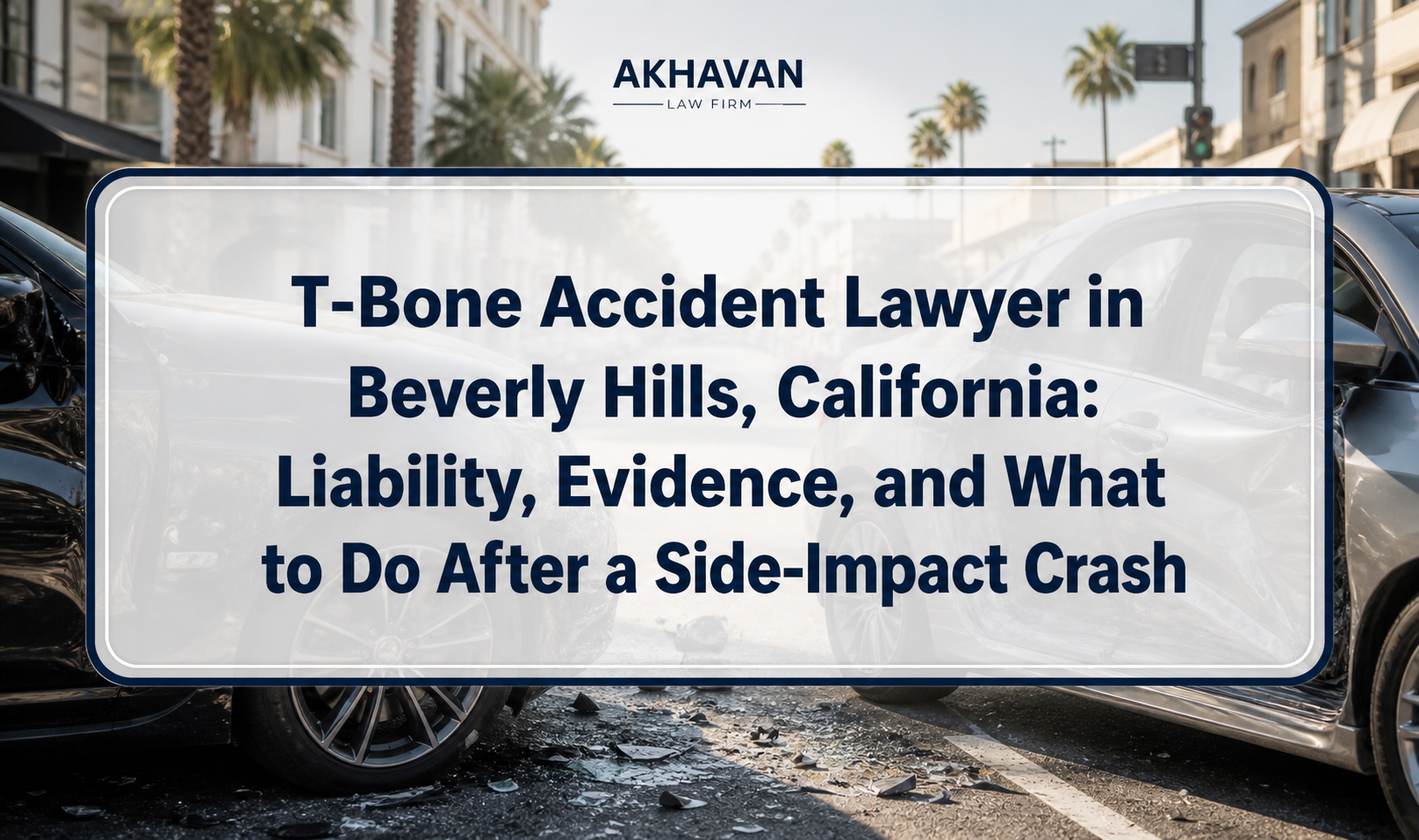
A T-Bone Accident Lawyer Beverly Hills can help determine liability and protect your rights after a side-impact crash, where one vehicle strikes the side of another in an intersection, driveway exit, or turn scenario. These collisions often raise immediate questions about who had the right of way, whether a driver ran a red light or stop sign, and how insurance companies assign fault under California’s comparative negligence rules.
Because side-impact impacts can cause serious injuries even at moderate speeds, early evidence preservation matters. Useful proof may include traffic-signal timing information, intersection surveillance or nearby security video, dashcam footage, vehicle “black box” (EDR) data, police reports, photos of skid marks and debris fields, and witness statements collected before memories fade.
This guide explains common causes of T-bone crashes in Beverly Hills, what steps to take at the scene and in the days after, which records to keep for an insurance claim, and how fault disputes and damages are typically evaluated in California injury cases.
Why T-bone crashes are uniquely dangerous
Side-impact collisions concentrate crash forces into the door area, where there is less space between the point of impact and vehicle occupants. Even at city speeds, this can lead to serious injuries and immediate disputes over who had the right of way.
In a classic intersection T-bone, one driver is typically traveling straight through while another enters from a cross street, turns left, or pulls out from a driveway. Because the struck vehicle often has limited time to react, injuries can be severe even when vehicles don’t look heavily damaged.
A T-Bone Accident Lawyer Beverly Hills often focuses early on two practical questions: (1) what the traffic controls were doing (light phase, stop sign compliance), and (2) what each driver could reasonably see and do in the seconds before impact. Those details typically drive both liability and the value of an injury claim.
Common causes of T-bone accidents in Beverly Hills
Most side-impact crashes come down to right-of-way errors, inattention, or misjudged gaps in traffic. Understanding the most frequent scenarios can help you identify what evidence matters and why insurers dispute fault.
Signal and stop-sign violations
Running a red light or rolling through a stop sign is one of the most common triggers for a T-bone crash. Proving it often requires more than a driver’s word against another’s.
Useful proof may include intersection cameras (public or private), nearby business security footage, witness accounts, and the final resting positions of the vehicles. When available, traffic-signal timing and phasing data can help reconstruct whether a driver likely entered on red or late yellow.
Left turns across oncoming traffic
Many T-bones happen when a driver turns left and an oncoming vehicle continues straight. These cases frequently hinge on whether the turning driver yielded appropriately and whether the oncoming driver was speeding or distracted.
Insurers often argue “shared fault” in left-turn crashes, especially if there are allegations of speeding, aggressive driving, or lane changes by the through-driver. That makes early scene documentation and witness contact information especially valuable.
Driveway and parking-lot exits
Pulling into traffic from a driveway or parking lot can create a sudden, close-range side impact with little braking time. Visibility issues (parked cars, landscaping, lighting) are commonly raised in these claims.
In Beverly Hills, side streets and commercial driveways can have visual obstructions that become key evidence. Photos taken from each driver’s viewpoint at a similar time of day can help illustrate what was and wasn’t visible.
Distracted or impaired driving
Distraction and impairment can delay reaction time and lead to entering an intersection unsafely. These factors may also support claims for higher damages when supported by evidence.
Phone records are not automatically available to a claimant; they typically require legal process or cooperation. Police observations, citations, field sobriety notes, and witness statements can still be important indicators when impairment is suspected.
What to do at the scene and in the days after
Your health comes first, but the steps you take early can strongly affect what you can prove later. The goal is to get medical care and preserve perishable evidence before it disappears.
At the scene: safety, documentation, and reporting
Right after a side-impact crash, prioritize safety and create a clean record of what happened. Avoid arguments; stick to collecting information and requesting help.
- Call 911 and request medical assistance if anyone reports pain, dizziness, confusion, or numbness.
- If safe, photograph vehicle positions before they are moved (wide shots and close-ups).
- Capture the intersection controls: traffic lights, stop signs, lane arrows, crosswalk markings, and any visibility obstructions.
- Photograph skid marks, debris fields, gouge marks, and fluid trails (these can help with impact point and speed analysis).
- Get contact information for witnesses and ask them to briefly text/email what they saw while it’s fresh.
- Exchange driver and insurance information; note the license plates and the VIN if visible.
- Cooperate with police, but avoid guessing about speed or admitting fault.
If you’re unsure what to do next, the step-by-step guidance in after an auto accident: the steps you need to take can help you organize the immediate aftermath.
Medical care: why “wait and see” can backfire
Side impacts can cause injuries that worsen over hours or days, including concussions and soft-tissue injuries. Prompt evaluation creates a clearer medical timeline and may reduce the risk of complications.
- Get checked the same day if possible, especially for head impact, nausea, vision changes, or neck/back pain.
- Follow up if symptoms evolve; delayed onset is common with whiplash-type injuries.
- Be consistent and accurate when describing symptoms; underreporting can become an insurance dispute later.
Evidence to preserve (and how to preserve it)
Many of the best sources of proof in a T-bone case are time-sensitive. Preserving them early can make fault clearer and reduce “he said/she said” disputes.
- Video: ask nearby businesses or residences to retain footage; many systems overwrite within days.
- Dashcam: download the clip and back it up; don’t rely on the device keeping it indefinitely.
- Vehicle data: modern vehicles may store crash-related data (commonly referred to as EDR data), but access can require specialized steps and should be handled carefully to avoid spoliation disputes.
- Phone records: if distraction is suspected, preserve your own records and discuss lawful methods to request opposing records.
- Repair/total loss documentation: keep tow invoices, storage notices, adjuster emails, and photos before repairs.
How fault is evaluated under California comparative negligence
California generally applies “pure comparative negligence,” meaning fault can be shared and damages reduced by a party’s percentage of responsibility. Insurers often use this framework to argue you should receive less, even when the other driver caused the collision.
In practice, liability decisions frequently turn on objective details: signal status, vehicle speeds, line of sight, and whether a driver had time to avoid the crash. A T-Bone Accident Lawyer Beverly Hills may work with accident reconstruction and medical experts when the stakes or injuries justify it.
Evidence that commonly shifts fault percentages
Because side-impact cases often involve conflicting stories, certain evidence tends to carry disproportionate weight.
- Independent witnesses: third-party observations can resolve red-light disputes.
- Intersection video: even partial angles can show entry timing and right-of-way.
- Vehicle damage patterns: impact points can support who struck whom and at what angle.
- EDR/telematics data: may indicate braking, speed, and throttle input immediately before impact (availability varies by make/model).
- Police report details: diagrams, party statements, and cited violations can influence insurance negotiations (though reports aren’t always definitive).
What if you were partly at fault?
Partial responsibility does not necessarily eliminate your claim, but it can reduce recovery. It also affects strategy: documentation and credible medical records become even more important when liability is contested.
Common allegations in T-bone cases include “you sped up at the yellow,” “you changed lanes in the intersection,” or “you were distracted.” If any of those are raised, preserving objective data (video, EDR, photos) can be decisive.
Damages in a Beverly Hills T-bone accident claim
Compensation in an injury case usually focuses on medical costs, lost income, and the human impact of the injuries. The value of a claim depends on provable losses, injury severity, and how clearly fault can be established.
Economic damages: the measurable losses
Economic damages generally include out-of-pocket and documentable financial harm. Keeping organized records is one of the simplest ways to strengthen your claim.
- Ambulance, ER, imaging, surgery, medications, and follow-up care
- Physical therapy and rehabilitation
- Future medical care needs when supported by medical opinion
- Lost wages and diminished earning capacity (when supported by employment and medical records)
- Property damage and related expenses (towing, rental, storage)
Non-economic damages: pain, limitations, and quality-of-life impact
Non-economic damages can cover pain, mental distress, and lifestyle limitations, but they are less straightforward to prove. Consistent medical documentation and a clear narrative of daily limitations often matter more than dramatic one-time statements.
- Document symptom progression in a simple journal (sleep disruption, headaches, driving anxiety, range-of-motion limits).
- Track missed activities (childcare, exercise, work duties) and note who had to step in.
- Avoid exaggeration; credibility is a practical asset in settlement talks and litigation.
Severe injury and wrongful death considerations
High-impact T-bone crashes can cause traumatic brain injury, spinal injuries, and internal trauma. These cases may involve complex future-care needs and long-term loss calculations that require professional evaluation.
When a collision results in a fatality, a surviving family may have a separate legal pathway for recovery. If you need information about fatal-collision claims, see wrongful death.
Insurance tactics you should anticipate after a side-impact crash
Insurance companies often move quickly in T-bone cases because liability can be disputed and injuries can be costly. Knowing common tactics can help you avoid unforced errors.
- Recorded statements: adjusters may request them early; what you say can be used to argue inconsistencies later.
- Quick, low offers: early settlements may not account for future treatment or delayed symptoms.
- Minimizing injuries: insurers may argue a “minor impact” caused only minor harm, despite well-known variability in injury response.
- Shifting blame: comparative negligence arguments (speeding, distraction, “you should have avoided it”) are common.
It can help to understand how the legal role is typically defined in these cases; a personal injury lawyer commonly investigates liability, develops damages evidence, and negotiates or litigates to resolve the claim.
Reference table: key evidence types and how they’re commonly used
The most persuasive evidence in a T-bone collision is often time-sensitive and scenario-specific. This table summarizes common proof sources and practical considerations that frequently arise in Beverly Hills-area intersection crashes.
| Evidence Type | What It Can Show | Practical Notes in Beverly Hills Cases |
|---|---|---|
| Intersection or nearby security video | Signal phase, entry timing, turn path, whether a vehicle stopped | Many systems overwrite quickly; requesting preservation early can be critical |
| Dashcam footage | Right-of-way context, speed cues, braking, lane position | Download and back up immediately; avoid editing that could prompt authenticity disputes |
| Vehicle EDR (black box) data | Pre-crash speed, braking, throttle input (availability varies) | Access is vehicle- and circumstance-dependent; preserve the vehicle before repairs/total-loss disposal |
| Scene photos (skids, debris, sight lines) | Point of impact, avoidance attempts, visibility conditions | Photos taken from driver eye-level and at similar time-of-day can address “couldn’t see” defenses |
| Witness statements | Independent confirmation of red-light running, speeding, or failure to yield | Collect contact info on scene; memories fade and people become hard to locate |
When to consider a lawyer for a Beverly Hills T-bone crash
Not every crash requires legal representation, but side-impact collisions commonly involve contested liability and meaningful injuries. A lawyer can be especially helpful when you need evidence preserved quickly or when fault is being shifted onto you.
- You were taken by ambulance or diagnosed with concussion, herniation, fractures, or other significant injuries.
- The other driver denies running the light/stop sign or disputes the turn/right-of-way sequence.
- There were multiple vehicles, rideshare involvement, or commercial drivers (more policies and defenses).
- You’re receiving pressure to give a recorded statement or accept a fast settlement.
- Your vehicle is at risk of being repaired or totaled before documentation and data preservation.
For collisions involving standard passenger vehicles, reviewing options for a car accident claim can help you understand how liability and damages are typically built.
Moving forward with a clearer plan after a side-impact collision
The best next step is usually a disciplined, documentation-first approach: get medical care, preserve evidence, and avoid decisions that lock in an undervalued claim. With T-bone accidents, clarity about right of way often comes from small details that are easy to lose if you wait.
If you’re dealing with a fault dispute, prioritize collecting video, witness information, and complete medical records before focusing on negotiations. Whether you handle the claim yourself or work with a T-Bone Accident Lawyer Beverly Hills, strong early documentation can make liability and damages much easier to prove.
Frequently Asked Questions
Talk through your Beverly Hills T-bone crash before evidence disappears
If you were hurt in a side-impact collision, the next steps often depend on details that are easy to lose—traffic-signal timing, nearby video, witness contact info, and the documentation that supports your medical timeline. A focused review can help you understand what records to gather, how comparative negligence may affect fault arguments, and what a fair claim evaluation typically considers.
Getting guidance can be especially helpful if the other driver disputes the light, you’re being asked for a recorded statement, or you’re unsure how to document injuries that developed after the crash.
Disclaimer: The information provided on this page is for general informational purposes only and should not be considered legal advice. Reading this page, using this website, or contacting us through this page does not create an attorney-client relationship. Every legal matter is different, and the information here may not apply to your specific situation. You should not act or rely on any information on this page without first consulting a qualified attorney about your individual case.

Edwin E. Akhavan is the founding attorney of Akhavan Law Firm APC, a personal injury law firm in Beverly Hills, California. State Bar of California #270338. About the firm