On this page
- Executive Key Takeaways
- The First 10 Minutes: Secure Safety and Preserve Evidence
- Driver and Vehicle Identification: Get Verifiable, Claim-Usable Details
- Insurance Information: Capture What the Adjuster Actually Needs
- Crash Scene Documentation: Build a Record That Explains How the Impact Happened
- Photo and Video Checklist: What to Capture So It Holds Up Later
- Witness and Third-Party Information: Independent Accounts Matter Most
- Police Response and Reporting Rules: Document What Was (and Wasn’t) Officially Recorded
- Medical and Symptom Tracking: Low-Speed Impacts Still Cause Real Injury
- Information You Should NOT Share at the Scene
- Core Fender-Bender Documentation Table (Checklist You Can Follow)
- After You Leave the Scene: Preserve the Claim File
- When a “Minor” Crash Becomes a Legal Case
- Field-Ready Wrap-Up: The Information That Protects You Most
- Frequently Asked Questions
- Don’t Let a “Minor” Fender Bender Turn Into a Major Money Problem
Executive Key Takeaways
Executive Summary: After a fender bender, collect verifiable identity, vehicle, and insurance details for every driver, then document the scene with photos, notes, witness contacts, and any police report information so your insurance claim can be proven instead of debated. If symptoms appear later, track onset and medical visits to connect injuries to the crash with a clear timeline.
- Prioritize claim-usable identifiers: Get each driver’s legal name, contact information, driver’s license details, plate number, and each vehicle’s VIN (photo the dashboard VIN plate) so coverage and vehicle involvement can be confirmed without guesswork.
- Document mechanics, not just damage: Photograph wide-to-close scene evidence (lanes, signals/signs, final rest positions, skid/debris, weather/visibility) plus all sides and close-ups of damage to show how the impact happened, not merely that it occurred.
- Lock in independent and official support: Capture witness contacts with a one-line summary, record the responding officer’s name/badge and report or incident number (or note if no report), and keep a symptom/medical log if any injury signs develop after leaving the scene.
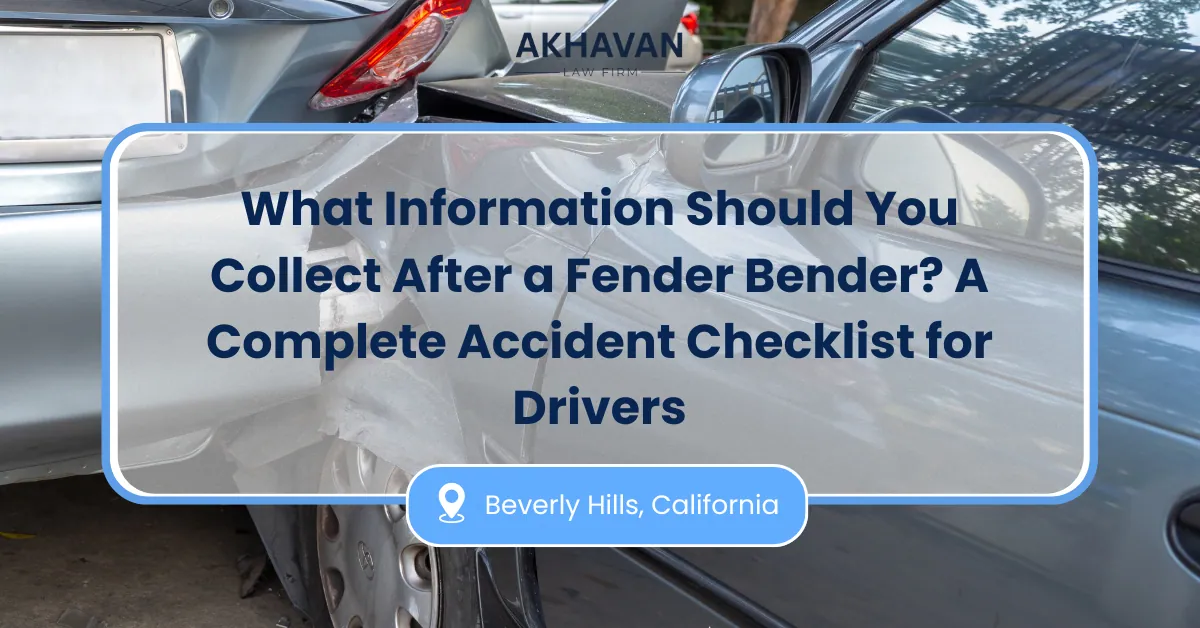
After a fender bender, you should collect the other driver’s identity, vehicle details, insurance data, crash documentation, and witness information to protect your claim and comply with local reporting rules. What Information Should I Collect After a Fender Bender? Start with the full legal name, phone number, home address, driver’s license number, and license plate number for every driver involved. Record the insurance carrier name, policy number, and the insurer’s claim phone line shown on the insurance card. Confirm the vehicle year, make, model, color, and VIN from the dashboard plate at the base of the windshield. Note the exact location with cross streets, direction of travel, lane position, and nearby mile markers or intersection controls, such as a stop sign, protected left arrow, or flashing signal. Photograph all four corners of each vehicle, close-ups of paint transfer, bumper clips, cracked lenses, and undercarriage drips, plus wide shots showing final rest positions and skid marks. Capture the full scene, including traffic signage, road defects, construction cones, and weather conditions like standing water or glare. Get witness names and numbers, and write a one-line summary of what each person saw. Request the responding officer’s name, badge number, and report or incident number, and document whether the crash was handled as an exchange-only event or a formal report. If medical issues arise, log the time symptoms started, the facility visited, and discharge paperwork details, since delayed neck or back pain is common in low-speed impacts.
The First 10 Minutes: Secure Safety and Preserve Evidence
Prioritize safety first, then preserve time-sensitive evidence before vehicles are moved or the roadway changes. What you do immediately after impact often determines what can be proven later.
Use this order of operations:
- Check for injuries and call 911 if anyone reports pain, dizziness, bleeding, or confusion.
- Move out of active traffic if the vehicles are drivable and it is safe; if not, turn on hazard lights and stay clear of traffic lanes.
- Do not argue fault at the scene. Stick to exchanging required information and documenting conditions.
- Capture quick “before anything changes” photos (positions, lanes, signals) if it can be done safely.
If the crash creates a hazard (blocked lane, fluids, debris), reporting it is not optional in practice—hazard conditions can expose drivers to additional risk and complicate later liability arguments if the scene escalates.
Driver and Vehicle Identification: Get Verifiable, Claim-Usable Details
The core goal is to identify every involved driver and match each person to a specific vehicle. Insurers and attorneys rely on identifiers that can be cross-checked: license numbers, plates, and VINs.
Collect the following from each driver (not just the registered owner):
- Full legal name (as shown on driver’s license)
- Mobile phone number and a secondary number if available
- Home address
- Driver’s license number and issuing state
- License plate number (and state)
Collect the following about each vehicle:
- Year, make, model, and color
- VIN (photograph the dashboard VIN plate at the base of the windshield; it is the fastest way to avoid transcription errors)
- Obvious modifications (tow hitch, aftermarket bumper, lift kit) that may affect damage patterns
If the driver is not the owner, record the registered owner’s name shown on insurance/registration, because coverage and permission issues can matter.
Insurance Information: Capture What the Adjuster Actually Needs
Insurance cards are not all the same, so photograph the card and also write down the key fields. A clear capture prevents delays when a claim is opened.
For each applicable policy, document:
- Insurance company name
- Policy number
- NAIC number (if listed) and/or the insurer contact/claims phone number shown on the card
- Named insured (who the policy belongs to)
- Vehicle listed on the card (confirm it matches the involved car)
- Policy effective dates (if shown)
If the other driver claims they are uninsured or “don’t have the card,” still collect identity and vehicle identifiers and ask police to respond if available. In California, you can also later pursue an uninsured motorist claim under your own policy if you have that coverage.
Crash Scene Documentation: Build a Record That Explains How the Impact Happened
Strong documentation shows not just damage, but mechanics: who had right of way, where vehicles were positioned, and what controlled the intersection. A scene record is often what separates a “word vs. word” claim from a provable one.
Write down these scene facts before you forget:
- Exact location (street names, nearest address or business frontage)
- Cross streets and direction of travel for each vehicle
- Lane position (e.g., “#2 lane,” turn pocket, merge lane, bike lane)
- Traffic control: stop sign, yield, signal phase (protected left arrow vs. permissive), flashing red, flashing yellow
- Roadway conditions: potholes, uneven pavement, construction zones, missing signs, faded lane lines
- Weather and visibility: rain, fog, glare, dusk lighting, standing water
- Time of collision (use phone timestamp) and approximate traffic density
If it is a rear-end impact, document spacing and signal status; rear-end cases are often treated as the trailing driver’s fault, but not always—sudden unsafe lane changes, abrupt reversals, brake-check allegations, or multi-car chain reactions can change liability analysis.
Photo and Video Checklist: What to Capture So It Holds Up Later
Photos should prove identity, damage, and the environment in one coherent set. Use wide-to-close sequencing so an adjuster or jury can understand what they’re looking at.
Use this structured capture list:
- Wide scene (10–30 seconds of video is ideal): show the roadway, intersection, signals/signs, and where each car ended up.
- All four corners of each vehicle: front, rear, left, right—include the license plate in at least one angle.
- Close-ups of damage: paint transfer, bumper clips, broken brackets, cracked lights, displaced sensors, trunk gaps, wheel scuffs.
- Underbody and leak indicators: dripping fluids, hanging panels, scraped components.
- Tire marks and debris: skid marks, gouges, broken plastic, glass patterns.
- Cabin indicators: deployed airbags, warning lights, seatbelt lockup marks (if visible/safe), child seat position if relevant.
- VIN photo: dashboard VIN plate for each involved vehicle if possible (or at least your own).
Practical tip: enable date/time/location metadata on your phone camera if you are comfortable doing so; it can help anchor timing and place when there is a dispute.
Witness and Third-Party Information: Independent Accounts Matter Most
Neutral witnesses often decide contested claims because they are not financially tied to the outcome. Get contact details quickly because witnesses leave.
For each witness, collect:
- Full name
- Phone number and email
- Best time to reach them
- Where they were standing/driving when they saw the collision
- A one-sentence summary in your notes (e.g., “Saw Vehicle B merge into Vehicle A’s lane without signal.”)
Also identify third parties that may have video:
- Nearby businesses with exterior cameras
- Residential doorbell cameras facing the street
- Transit vehicles or delivery trucks stopped nearby
Video is often overwritten quickly, so making a same-day request (or having counsel request preservation) can be critical.
Police Response and Reporting Rules: Document What Was (and Wasn’t) Officially Recorded
Whether an officer writes a full traffic collision report or only facilitates information exchange changes how you prove the event later. Even when police do not respond, you should still document that you attempted to report.
If an officer responds, record:
- Officer name and badge number
- Agency (city police, CHP, sheriff)
- Report number or incident/call number
- Whether citations were issued and for what general reason (don’t guess; write only what you’re told)
In California, you should also be aware of the DMV reporting requirement: Vehicle Code § 16000 requires a report (SR-1) to the DMV within 10 days when an accident results in injury/death or property damage over the statutory threshold. The exact threshold can change, so confirm current DMV instructions at the time you report rather than relying on memory or internet summaries.
Medical and Symptom Tracking: Low-Speed Impacts Still Cause Real Injury
Medical documentation should connect symptoms to the collision with clear timing and consistent reporting. Neck, back, and headache symptoms commonly appear hours later, and gaps in care are frequently used to dispute causation.
Create a simple symptom log that includes:
- When symptoms started (time and date)
- Body areas affected (neck, shoulder, low back, wrist)
- Specific functional limitations (couldn’t turn head, numbness, lifting limits, sleep disruption)
- Where you sought care (urgent care, ER, primary care) and the visit dates
- Discharge instructions, imaging results, and prescribed medications
Do not exaggerate or minimize symptoms. Accuracy is what makes records credible and useful in negotiations or litigation.
Information You Should NOT Share at the Scene
Limit discussion to safety and information exchange; avoid statements that can be interpreted as admissions. Many disputed claims begin with casual on-scene comments.
Avoid:
- “I’m sorry” statements that can be framed as fault admissions
- Speculating about speed, distance, or who “should have seen” whom
- Sharing unnecessary personal data (Social Security number, employer details)
- Signing any document you don’t understand (including private “settlement” notes)
You can be polite and cooperative while staying factual: exchange identification/insurance, confirm everyone is safe, and document the scene.
Core Fender-Bender Documentation Table (Checklist You Can Follow)
This table consolidates the most claim-relevant information into a single checklist. Use it as a field guide to ensure you capture identifiers, proof of conditions, and reporting details.
| Feature / Metric | Specifications | Local Guidelines |
|---|---|---|
| Driver identification | Name, phone, address, driver’s license #, license plate # (photo + written notes) | Exchange information at the scene; if a driver refuses or leaves, treat it as a hit-and-run and call police. |
| Insurance details | Carrier, policy #, claims phone line, named insured, effective dates (photo of card) | Open a claim using the insurer’s claims line shown on the card; keep screenshots/photos to avoid mis-keyed policy data. |
| Vehicle identifiers | Year/make/model/color, VIN (dashboard plate photo), visible modifications | VIN is the most reliable identifier for matching the correct vehicle to coverage and repair records. |
| Scene and traffic controls | Cross streets, lane position, signal/stop/yield controls, construction, road defects, lighting/weather | Photograph signs/signals and lane markings; document any obstruction or defect that could affect fault allocation. |
| Damage documentation | Wide shots + close-ups; all corners; paint transfer; lights; sensors; undercarriage leaks; debris/skid marks | Take photos before repairs or cleaning; keep towing and storage receipts tied to the same claim file. |
| Witnesses and video sources | Witness names/phones, short statement summary, business camera locations | Request preservation quickly because many systems overwrite footage in days, not months. |
| Police documentation | Officer name/badge, agency, report/incident #, whether it was exchange-only or a formal report | In California, DMV reporting rules may also apply; Vehicle Code § 16000 addresses reporting in injury/death or qualifying property-damage cases. |
After You Leave the Scene: Preserve the Claim File
The strongest claims are organized like a file, not a memory. Preserve documents and communications so you can prove expenses, timelines, and repair impact.
Create a single folder (cloud + local) and save:
- All photos/videos (do not delete “duplicates” until you review them on a larger screen)
- Tow invoice, storage fees, and rental car receipts
- Repair estimates and final repair bill; note if OEM vs. aftermarket parts were used
- Medical visit summaries, prescriptions, and physical therapy attendance logs
- Work impact: missed days and wage documentation if applicable
If an insurer asks for a recorded statement and you are unsure, pause and get guidance first. Misstatements about distance, timing, or prior symptoms are commonly used to reduce payouts.
When a “Minor” Crash Becomes a Legal Case
Small property damage does not automatically mean a small injury claim, and liability disputes can arise even in low-speed collisions. Legal help becomes more relevant when fault is contested, symptoms persist, or coverage problems appear.
Consider professional support if any of the following occur:
- The other driver denies involvement or changes their story
- There is a rideshare vehicle, commercial truck, or employer-owned vehicle involved (multiple policies may apply)
- You are diagnosed with a sprain/strain, disc issue, concussion symptoms, or need ongoing treatment
- The insurer disputes causation, delays repairs, or pressures a quick settlement
If you want a deeper understanding of what a personal injury lawyer actually does in motor-vehicle claims—investigation, liability proof, medical record development, and negotiation—it helps clarify whether representation fits your situation.
For collision-related injuries and disputed liability, you can also review options under a dedicated car accident service page to see how these cases are typically handled from intake through settlement or trial.
Rear-end impacts are a common example where “simple” crashes can still lead to serious outcomes; this report on a California jury award in a rear-end auto accident illustrates how damage mechanics and medical proof can drive case value when injuries are significant.
Field-Ready Wrap-Up: The Information That Protects You Most
The best post-crash checklist captures identity, coverage, vehicle identifiers, scene mechanics, independent witnesses, and medical timing. When you document these categories cleanly, you reduce disputes and shorten claim delays.
Use this final quick list as your “must-have” set:
- People: driver’s license data + phone + address for all drivers
- Vehicles: plates + VIN + year/make/model/color
- Coverage: insurer + policy number + claims phone line (photo the card)
- Scene: intersection controls, lanes, weather, and hazards (photos + notes)
- Proof: wide-to-close photos, debris/skids, and final rest positions
- Witnesses: names/numbers + one-line summary of what they observed
- Official record: officer info and report/incident number (or note if none)
- Health: symptom onset time and complete visit paperwork if you seek care
Collecting this information is not about being dramatic—it is about being precise. Precision is what turns a stressful moment into a clearly supportable insurance claim.
Frequently Asked Questions
Don’t Let a “Minor” Fender Bender Turn Into a Major Money Problem
In the moment, a fender bender feels simple: exchange info, snap a couple photos, move on. But “simple” crashes are where people accidentally sabotage their own claim—because the details that matter most (VIN, lane position, signal phase, witness contacts, exact scene conditions) are the first things to disappear.
Here’s the real risk of trying to handle it alone: insurance companies don’t pay based on what you meant to document—they pay based on what you can prove. If the other driver changes their story, “didn’t have their card,” denies injuries were related, or claims you admitted fault, you can end up stuck with repair bills, delayed medical coverage, and a settlement offer that doesn’t even match your out-of-pocket costs. And if you miss time-sensitive reporting steps, lose critical camera footage, or give an adjuster a recorded statement that’s inconsistent with the evidence, you’ve handed the other side the leverage.
An experienced local team can help you lock down the facts fast—identifying the right coverage, preserving evidence (including third-party video that may be overwritten), organizing your documentation, and protecting you from the common traps that reduce payouts. If injuries show up later (which is common), having a clean timeline and consistent records can be the difference between a supported claim and a denied one.
Disclaimer: The information provided on this page is for general informational purposes only and should not be considered legal advice. Reading this page, using this website, or contacting us through this page does not create an attorney-client relationship. Every legal matter is different, and the information here may not apply to your specific situation. You should not act or rely on any information on this page without first consulting a qualified attorney about your individual case.

Edwin E. Akhavan is the founding attorney of Akhavan Law Firm APC, a personal injury law firm in Beverly Hills, California. State Bar of California #270338. About the firm