On this page
- Executive Key Takeaways
- Immediate legal and safety priorities (first 10 minutes)
- Documentation that insurers and attorneys actually use
- Medical steps that protect your health and your claim
- Police reports and required reporting rules (California)
- Insurance communications: what to provide and what to refuse
- Property damage, towing, and rental cars (how to avoid common cost traps)
- Core after-crash timeline: a practical, claims-ready roadmap
- When the crash involves rideshare, trucks, pedestrians, or hit-and-run
- How fault and compensation are evaluated (and why your records matter)
- When to speak with a personal injury lawyer (clear triggers)
- Stay ready: the “72-hour” follow-through that strengthens your case
- The after-accident playbook that protects you
- Frequently Asked Questions
- Don’t Let One Crash Turn Into a Second Financial Hit
Executive Key Takeaways
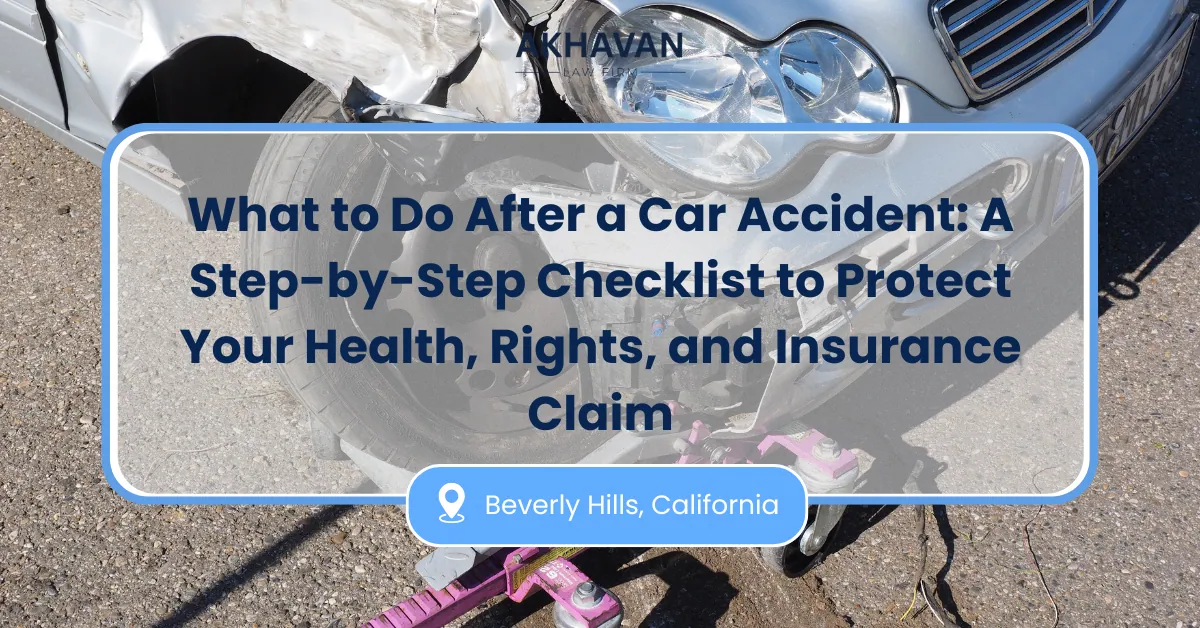
Executive Summary: What to do after a car accident is to secure safety first, create an official record, and preserve objective evidence while getting same-day medical evaluation to protect both your health and your insurance/legal rights.
- Stabilize the scene and escalate appropriately: Move to safety if lawful, use hazard lights, and call 911/request police when there are injuries, lane blockage, impairment, hit-and-run, or a non-drivable vehicle so there is a traceable incident/report number.
- Capture proof insurers rely on: Collect wide-to-close photos, identifiers (licenses/plates/VIN/insurance), road and traffic-control details, and short time-stamped witness observations while avoiding any admission of fault.
- Protect the claim with medical and reporting discipline: Get evaluated the same day for any symptoms, keep all medical/expense records and a daily impact log, notify your insurer with objective documentation, and meet California’s SR-1 DMV reporting deadline when required.
What to Do After a Car Accident is a step-by-step process to secure safety, document evidence, get medical care, and protect your legal and insurance rights. Move to a safe area if you can do so without risk. Turn on hazard lights. Check for injuries. Call 911 and request police and EMS if anyone reports pain, dizziness, bleeding, or head impact. If the crash is blocking traffic or involves suspected impairment, insist on an officer response and ask for the incident or report number. Exchange full names, phone numbers, driver’s license numbers, plate numbers, and insurance policy details. Photograph the scene from multiple angles. Include vehicle positions, skid marks, debris fields, traffic signals, and road conditions like rain, glare, or potholes. Capture close-ups of impact points and wider shots that show lane markings and intersection layout. Record the time, nearest cross street, and direction of travel. Collect witness names and a short statement on what they saw, such as “Vehicle A ran the red light” or “Vehicle B merged without signaling.” Avoid admitting fault at the scene. Stick to observable facts. Seek medical evaluation the same day, even if symptoms feel minor, because whiplash, concussions, and soft-tissue injuries can present hours later. Save all documents, including discharge instructions, imaging orders, and work restrictions. Notify your insurer promptly and provide the police report number, photos, and witness list. Track expenses and impacts in a simple log, including tow fees, rideshare receipts, rental days, missed work hours, and pain or mobility limits, because these details can affect claim valuation and coverage decisions.
Immediate legal and safety priorities (first 10 minutes)
Summary: Your first goal is to prevent a second collision and create an official record. If there is any injury complaint, hazard, or suspicion of impairment, treat the crash as an emergency and escalate to 911 and an in-person officer response.
After you move out of active lanes (only if it is safe and lawful), secure the area and control the flow of information:
- Prevent secondary impacts: hazard lights on; if you carry them, set reflective triangles/flares at a safe distance behind the vehicles (do not stand in traffic).
- Confirm injuries with direct questions: “Do you feel pain, dizziness, nausea, or confusion?” Head impacts and seatbelt bruising can signal serious internal injury.
- Call 911 when any of the following exist: injuries; airbags deployed; a vehicle is not drivable; the crash is blocking a lane; a driver appears intoxicated; any threat or hit-and-run; property damage is significant.
- Request police presence when it matters: ask for the incident number and the responding agency (CHP vs. city police). This creates a traceable record for insurers and later claims.
If you are on a freeway, follow CHP or local instructions and avoid crossing lanes on foot. If someone is hurt, do not move them unless there is imminent danger (fire, traffic intrusion). That detail can become medically and legally important.
Documentation that insurers and attorneys actually use
Summary: The strongest claims are built on objective proof collected early: photos, measurements, identifiers, and neutral witness accounts. Your goal is to preserve facts that cannot be recreated days later.
In addition to the basics (names, phones, driver’s license numbers, license plates, and insurance), capture evidence that ties damage to mechanics of impact:
Scene photos: a complete checklist
Summary: Wide-to-close photos establish location, right-of-way controls, and vehicle dynamics. Take more than you think you need because insurers decide liability from what they can see.
- Wide shots: intersection layout, lane markings, turn arrows, crosswalks, and where each vehicle came to rest.
- Traffic control devices: signals, stop signs, “no turn” signs, construction detours, and any obstructed sign visibility.
- Road conditions: standing water, rain, sun glare direction, loose gravel, oil, potholes, or missing reflectors.
- Physical evidence: skid marks (start and end), yaw marks, gouges, debris field, and fluid trails.
- Vehicle details: VIN plates (often visible through the windshield), damage close-ups, airbag deployment, seatbelt marks, and interior damage that indicates occupant movement.
Witnesses: what to ask and how to record it
Summary: A short, time-stamped witness note can resolve disputed stories. Keep it limited to what they observed, not what they “think.”
- Get full name, mobile number, and email.
- Ask for a one-sentence observation (e.g., “The blue sedan entered on red,” “The truck changed lanes into the motorcycle”).
- Record where they were standing and their direction of view.
- If they will cooperate, ask them to text you their observation so the timestamp is preserved.
What not to say at the scene
Summary: Fault is a legal conclusion and can be misinterpreted later. Limit communication to safety and facts you directly observed.
- Avoid statements like “I’m sorry,” “I didn’t see you,” “I was speeding,” or “It’s my fault.”
- Do say: “Are you okay?” “Let’s call 911,” and “I’ll exchange information.”
- If asked about injuries, answer truthfully but briefly: “I’m not sure yet; I’m going to get checked today.”
Medical steps that protect your health and your claim
Summary: Same-day medical evaluation creates a baseline record and reduces the risk of missed injuries. Delays commonly lead insurers to argue the injury is unrelated or minor.
Even low-speed impacts can cause soft-tissue and brain injuries that appear later. Seek evaluation the day of the crash (urgent care, ER, or your physician) when you have:
- Head impact, confusion, headache, light sensitivity, memory gaps, nausea, or vomiting (possible concussion).
- Neck/back pain, stiffness, tingling, numbness, or weakness (possible whiplash, disc injury, nerve involvement).
- Chest/abdominal pain or significant bruising (seatbelt injuries can include internal trauma).
What to keep: discharge papers, imaging orders and results, prescriptions, physical therapy referrals, and work status notes. Also keep a daily log with pain level, sleep disruption, driving limitations, and missed activities; it becomes contemporaneous evidence if the claim is disputed.
Police reports and required reporting rules (California)
Summary: In California, certain crashes must be reported to the DMV regardless of fault. The police report helps, but it does not replace your DMV reporting duty.
- DMV reporting: California requires filing an SR-1 with the DMV within 10 days if there is injury/death or property damage of $1,000+ (this is separate from any police report).
- How to use the police report: obtain the report number at the scene; request the completed report from the agency when available; verify names, dates, insurance, and collision diagram for accuracy.
- If the officer does not respond: document the call reference number, and still complete the SR-1 if the threshold is met.
If you later find errors or missing witness information, gather your proof (photos, witness contact, medical visit records) and provide it to your insurer promptly. Do not alter photos; keep originals with metadata if possible.
Insurance communications: what to provide and what to refuse
Summary: Prompt notice is required by most policies, but you can control the content. Provide objective evidence and the report number; avoid recorded statements until you understand the scope of injuries and liability issues.
When you notify your carrier, be prepared with:
- Policy numbers (yours and the other driver’s, if available)
- Date/time/location and direction of travel
- Police incident/report number
- Photos and witness list
- Tow yard and body shop contact information
Key boundaries that protect you:
- Recorded statements: if an adjuster pushes for a recorded statement immediately, it is reasonable to decline until you’ve had medical evaluation and can review facts calmly.
- Medical authorizations: do not sign broad, open-ended releases. Requests should be limited to relevant treatment and dates.
- Quick settlements: early offers often arrive before the injury picture is clear. Once a release is signed, reopening the claim can be difficult or impossible.
Property damage, towing, and rental cars (how to avoid common cost traps)
Summary: Storage fees and repair delays can quietly become the largest out-of-pocket risk right after a crash. Move quickly to document damage, choose a repair path, and minimize daily charges.
- Tow decisions: ask where the vehicle is going and what daily storage costs are. If safe, consider towing to your home or a preferred shop rather than a high-fee yard.
- Pre-repair photos: take full exterior and interior photos before any work begins.
- Rental coverage: confirm whether you have rental reimbursement and the per-day cap. Keep receipts and rental days tied to repair timeline documentation.
- Total loss handling: if the vehicle is totaled, keep maintenance records, recent comparable listings, and proof of upgrades to support valuation.
Core after-crash timeline: a practical, claims-ready roadmap
Summary: Following a time-based plan reduces missed deadlines and strengthens credibility. The goal is clean records: medical, financial, and factual.
| Feature / Metric | Specifications | Local Guidelines |
|---|---|---|
| At-scene evidence capture | Photos (wide + close), witness contacts, IDs/insurance, incident/report number | Request CHP/city response when injury, lane blockage, hit-and-run, or suspected DUI is involved |
| Medical baseline timing | Same-day evaluation when any pain, head impact, or neurologic symptoms exist | Keep discharge papers, imaging orders/results, prescriptions, and work-status notes |
| California DMV report (SR-1) | File within 10 days if injury/death or property damage ≥ $1,000 | Required even if police report exists and regardless of fault |
| Insurance notice | Report promptly with facts, photos, witness list, and report number | Avoid broad medical releases and premature recorded statements |
| Expense and impact log | Tow/storage, rentals, rideshare, prescriptions, co-pays, missed work, limitations | Maintain receipts and a dated journal to support economic and non-economic damages |
When the crash involves rideshare, trucks, pedestrians, or hit-and-run
Summary: Non-standard crashes require extra identifiers and faster evidence preservation. Liability and insurance layers can change depending on vehicle type, driver status, and available coverage.
Rideshare (Uber/Lyft) collisions
Summary: The app status at the moment of impact controls which insurance layer may apply. You need documentation that proves whether the driver was offline, waiting for a request, en route, or carrying a passenger.
- Screenshot the trip screen, driver profile, time, and route details.
- Get the rideshare driver’s personal insurance plus any app-provided claim instructions.
- Report the crash in the app and keep confirmation messages.
Commercial trucks
Summary: Truck cases often turn on records that can be lost if not preserved early. Identify the carrier and capture DOT-related markings immediately.
- Photograph the truck’s DOT numbers, company name, trailer number, and plate(s).
- Document cargo spills, underride damage, and road debris patterns.
- Get names of the trucking company and any on-scene safety personnel.
Pedestrian or bicycle impacts
Summary: Right-of-way and visibility evidence matters most: signals, crosswalk placement, and line-of-sight obstructions. Medical documentation should be immediate due to higher injury risk.
- Photograph crosswalk markings, signal phase indicators, and curb ramps.
- Document helmet damage, torn clothing, and shoe scuffs (impact mechanics evidence).
- Ask nearby businesses about camera coverage; note exact addresses.
Hit-and-run
Summary: The priority is immediate reporting and rapid identification, not confrontation. The best evidence is often partial: plate fragments, vehicle make/model, and direction of flight.
- Call 911 and provide direction of travel, color, make/model, and partial plate if known.
- Look for nearby cameras (gas stations, intersection cams, building entrances) and record addresses.
- Preserve any vehicle fragments left behind; photograph them in place first.
If you need focused guidance for a specialized scenario, review a dedicated hit-and-run accident service page for the specific evidence and claim issues that arise when the other driver is unidentified.
How fault and compensation are evaluated (and why your records matter)
Summary: Liability is assessed using physical evidence, statements, and statutory duties like safe speed and right-of-way. Your compensation is anchored to medical proof, wage loss documentation, and credible day-to-day impact records.
Insurance and litigation evaluate:
- Liability: traffic control compliance, lane position, following distance, impairment evidence, and corroborating witnesses.
- Medical causation: how closely treatment timing and symptoms align with the crash mechanics shown in photos and damage patterns.
- Damages: medical bills, future care needs, lost wages, loss of earning capacity, and non-economic harm (pain, limitations, sleep disruption).
High-value outcomes in rear-end collisions often turn on detailed injury documentation, credible testimony, and consistent treatment history. For an example of how rear-end liability and injuries can translate into significant case value, see California jury awards man $9 million in rear-end auto accident.
When to speak with a personal injury lawyer (clear triggers)
Summary: Legal help is most useful when injuries are more than minor, fault is disputed, multiple policies apply, or the insurer pressures you to settle quickly. Early advice can prevent evidence loss and deadline mistakes.
Consider a legal consult if any of the following applies:
- You went to the ER/urgent care, were referred for imaging, or need physical therapy/chiropractic care.
- You missed work, have work restrictions, or your symptoms persist beyond a few days.
- Fault is disputed, there are multiple vehicles, or the other driver is uninsured/underinsured.
- The crash involved a commercial vehicle, rideshare driver, public transit, or a government entity roadway defect.
- You are being asked for a recorded statement or a broad medical release.
A personal injury lawyer typically coordinates evidence preservation, medical documentation organization, lien/billing issues, and negotiation strategy so the claim presentation matches what adjusters and juries require for proof.
Stay ready: the “72-hour” follow-through that strengthens your case
Summary: The first three days are when symptoms emerge, memories fade, and vehicles get repaired or totaled. Use this window to lock down documents and stabilize your narrative with time-stamped records.
- Back up all photos and videos to cloud storage; keep originals.
- Write a brief timeline (before, during, after impact) including weather, speed estimate, and what you saw/heard.
- Get medical follow-up if symptoms change (new headache, radiating pain, numbness, dizziness).
- Request the police report instructions and diarize the availability date.
- Start a single folder for receipts, work notes, rental/tow bills, and insurer communications.
The after-accident playbook that protects you
Summary: The most effective response combines safety, evidence, medical care, and disciplined insurance communication. If you treat the crash like a documentable event with deadlines, you protect both your health and your financial recovery.
Use this final checklist as your standard operating procedure:
- Safety first: prevent a second crash, call 911 for injury or hazards, and secure an incident/report number.
- Evidence next: wide-to-close photos, road conditions, identifiers, and neutral witness statements.
- Medical baseline: same-day evaluation when any symptoms exist; keep every instruction and record.
- Meet reporting duties: file California SR-1 within 10 days when the threshold is met.
- Control the claim: provide facts and documentation; avoid rushed recorded statements and broad authorizations.
- Track costs and limitations: receipts + a daily impact log consistently increase clarity and claim valuation support.
Frequently Asked Questions
Don’t Let One Crash Turn Into a Second Financial Hit
Right after a car accident, most people focus on the obvious damage—then the real damage shows up later: injuries that didn’t hurt yet, missing photos that would’ve proved fault, a police report that doesn’t capture what actually happened, and an insurance adjuster who sounds friendly while quietly building a file that minimizes your claim.
Here’s the operational risk of trying to handle this on your own: evidence disappears fast. Skid marks fade. Vehicles get repaired or totaled. Witnesses stop answering. Surveillance footage gets overwritten. Meanwhile, deadlines keep moving—California’s SR-1 reporting clock doesn’t pause because you’re in pain or waiting for the police report. And once you give the wrong recorded statement, sign a broad medical authorization, or accept a quick settlement before your symptoms fully appear, you may not get a second chance.
An experienced local personal injury team helps you lock down the right proof early, control what gets said (and what doesn’t), document injuries the way insurers actually evaluate them, and prevent expensive “small” mistakes—like towing/storage fees, repair delays, and gaps in care—from quietly draining your recovery.
Disclaimer: The information provided on this page is for general informational purposes only and should not be considered legal advice. Reading this page, using this website, or contacting us through this page does not create an attorney-client relationship. Every legal matter is different, and the information here may not apply to your specific situation. You should not act or rely on any information on this page without first consulting a qualified attorney about your individual case.

Edwin E. Akhavan is the founding attorney of Akhavan Law Firm APC, a personal injury law firm in Beverly Hills, California. State Bar of California #270338. About the firm