On this page
- Key Takeaways
- How Liability Is Determined in a Head-On Collision
- Evidence That Often Decides Fault (and How to Preserve It)
- Medical Documentation: Connecting Injuries to the Collision
- How Compensation Is Evaluated After a Head-On Collision
- Head-On Collision Claim Timeline: What Usually Happens Next
- When Insurance Coverage Becomes the Real Battle
- What Not to Do After a Head-On Crash (Because It Can Be Used Against You)
- Why Legal Support Can Matter Early in a Disputed Head-On Case
- Making Confident Next Steps After a Head-On Collision
- Frequently Asked Questions
- Talk With a Beverly Hills Head-On Collision Attorney About Your Options
Key Takeaways
Head-on collision claims in California are often decided by which driver entered opposing traffic, but disputed cases typically require objective proof beyond competing statements. Early, time-sensitive evidence preservation and consistent medical documentation can reduce comparative fault and causation disputes while supporting compensation for economic and non-economic losses.
- Liability turns on lane position and pre-impact decisions: Investigators and insurers usually focus on who crossed the center line or entered the wrong lane, while also examining contributing factors like unsafe passing, distraction, impairment, speeding, or wrong-way travel and raising comparative fault arguments when narratives conflict.
- Time-sensitive evidence often decides contested fault: Photos of the roadway and vehicle positions, tire marks, debris fields, third-party video, witness statements, and vehicle data like EDR information may be critical, but cameras can be overwritten and vehicles repaired or salvaged quickly, making early preservation important.
- Documentation drives compensation and reduces disputes: Insurers generally value claims through medical records, bills, wage proof, and evidence of daily impact, and they are more likely to challenge cases involving delayed treatment, prior similar conditions, inconsistent statements, or limited wage-loss documentation.
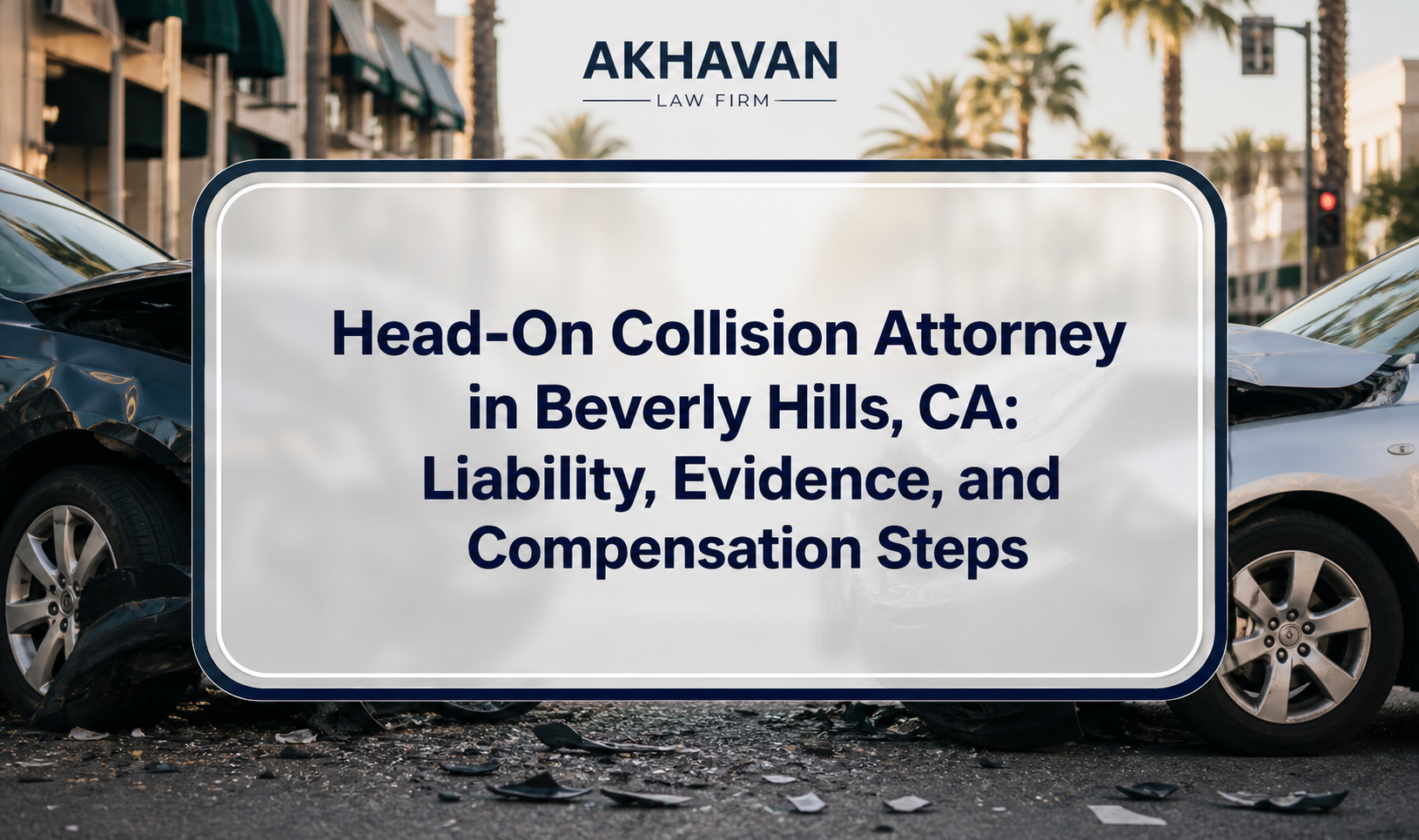
A Head-On Collision Attorney Beverly Hills can help you investigate fault, preserve critical evidence, and pursue compensation after a crash involving severe injuries or disputed liability. In California, determining responsibility often hinges on which driver crossed the center line or entered opposing traffic, and early legal guidance can reduce the risk of lost evidence or damaging insurer statements.
Head-on collisions frequently involve complex factors such as unsafe passing, distracted or impaired driving, speeding, or wrong-way travel, and they may require crash-scene documentation, vehicle damage analysis, event data recorder information, and witness statements. Insurance companies may also argue comparative fault, making timely documentation and medical records important for connecting injuries to the collision.
This article explains the steps that typically matter most—how liability is evaluated, what evidence to gather (and how to preserve it), and how compensation is calculated for medical expenses, lost income, and pain and suffering—so you can make informed decisions from the start.
How Liability Is Determined in a Head-On Collision
Liability in a head-on crash usually comes down to which driver entered the wrong lane, but insurers and investigators often look deeper at why it happened and whether multiple factors contributed.
In California, a head-on collision claim typically focuses on lane position and driving decisions in the seconds before impact. The most common allegation is that one driver crossed the center line or drove the wrong way, but real-world cases can involve competing narratives—especially when both drivers are injured and memories are incomplete.
A Head-On Collision Attorney Beverly Hills will often start by identifying every plausible liability theory, then narrowing to the strongest one supported by physical evidence, records, and third-party documentation. This matters because insurers may raise comparative fault arguments, claiming the injured person could have avoided the crash or contributed through speed, distraction, or lack of lighting.
Common fault scenarios in Beverly Hills and surrounding Los Angeles roads
Head-on crashes often stem from a handful of recognizable patterns, each requiring different proof.
- Unsafe passing: A driver crosses double yellow lines or enters oncoming lanes to pass and runs out of space.
- Left-turn errors: A driver turns left across opposing traffic or misjudges speed and distance.
- Wrong-way driving: Entry onto a one-way street, freeway on-ramp, or divided roadway in the wrong direction.
- Drift across center line: Distraction, fatigue, impairment, or medical episode causes unintentional lane departure.
- Speeding and loss of control: Overcorrection, aggressive lane changes, or sliding into opposing lanes.
Because Beverly Hills traffic frequently blends local streets with quick transitions to major corridors, lane changes and navigation errors can become a disputed issue. When fault is contested, the case often becomes evidence-driven rather than statement-driven.
Evidence That Often Decides Fault (and How to Preserve It)
The most persuasive head-on collision cases are built on time-sensitive evidence—photos, vehicle data, third-party video, and medical documentation—collected before it disappears.
Even when a police report exists, it may not capture everything needed to prove how the crash occurred. Cameras get overwritten, vehicles are repaired or totaled, and witnesses become harder to locate. Early preservation is especially important in severe-injury collisions, where the stakes are high and liability may be disputed.
Crash-scene evidence to gather as early as possible
Scene details help reconstruct lane placement and pre-impact maneuvers, which are central to head-on liability.
- Wide-angle photos: Capture the full roadway, lane markings, signage, and sightlines.
- Vehicle positions: Final rest locations and any marks indicating post-impact movement.
- Tire marks and gouges: Skids, yaw marks, and roadway scrapes can support speed/avoidance arguments.
- Debris field: Where parts and fluids are located may correlate with point of impact.
- Weather/lighting conditions: Sun glare, darkness, rain, and visibility obstacles can matter.
If you cannot safely collect evidence yourself, note what you remember and where it occurred (cross streets, direction of travel, lane count). Those details can help an investigator later locate cameras or confirm roadway design.
Vehicle evidence: damage patterns and event data
Vehicle damage and electronic data can corroborate direction of travel, braking, steering, and speed trends leading up to impact.
- Damage mapping: Front-end crush, offset impact, and intrusion patterns can help show angles and lane alignment.
- Event Data Recorder (EDR): Some vehicles store pre-crash information such as speed, braking, and throttle (availability varies by vehicle and condition).
- Airbag control module information: May record crash pulse data relevant to severity.
- Post-crash vehicle access: Preservation letters can be used to reduce the risk of spoliation if a vehicle is being salvaged.
Because tow yards and insurers may move quickly, it’s common for attorneys to act early to preserve vehicles and request that downloads or inspections occur before disposal or dismantling.
Third-party documentation: video, witnesses, and digital trails
Independent sources often make the difference when both drivers claim they stayed in their lane.
- Nearby surveillance: Businesses, parking structures, and residential systems may have exterior cameras facing the street.
- Dashcam footage: Either vehicle, other motorists, or rideshare recordings (where available).
- 911 and dispatch logs: Time-stamped calls can support the timeline and early observations.
- Witness statements: Neutral witnesses can clarify which vehicle crossed the line or attempted a pass.
- Cell phone evidence: In some cases, usage data may be relevant to distraction claims (obtaining it can require legal process and must be handled properly).
If you identify a potential camera source, time matters. Many systems overwrite footage quickly, and requests should be made as soon as possible.
Medical Documentation: Connecting Injuries to the Collision
Clear medical records help link your symptoms and diagnoses to the crash, which is essential when insurers argue the injuries were pre-existing or unrelated.
Head-on collisions commonly produce high-energy trauma, but insurers may still question causation—especially for neck/back pain, concussions, or injuries that worsen over days. Consistent treatment records and complete symptom reporting strengthen the medical narrative.
Injuries frequently seen in head-on impacts
The force vectors in a head-on crash can cause multi-system injuries, making thorough evaluation important.
- Head and brain injuries: Concussion, traumatic brain injury, post-concussive symptoms.
- Spine injuries: Herniated discs, fractures, nerve compression, radiculopathy.
- Chest and abdominal trauma: Rib fractures, internal injuries, organ damage.
- Orthopedic injuries: Fractures, ligament tears, shoulder and knee trauma.
- Psychological harm: Anxiety, driving phobia, sleep disruption, PTSD-like symptoms.
Follow-up care matters not only for recovery but for documentation. If symptoms change—headaches worsen, numbness appears, pain radiates—report it promptly so it is recorded.
Practical medical steps that help protect your claim
Small documentation gaps are commonly used by insurers to argue that injuries are exaggerated or unrelated.
- Attend recommended follow-ups: Missed appointments can be framed as lack of seriousness.
- Be specific about symptoms: Note location, severity, duration, and triggers.
- Track limitations: Document work restrictions, household help needed, and activity changes.
- Keep records organized: Discharge papers, imaging results, prescriptions, and PT notes.
Medical decisions should always be based on health needs, but consistent, well-documented care tends to reduce disputes about causation and severity.
How Compensation Is Evaluated After a Head-On Collision
Compensation generally reflects economic losses (bills and income) and non-economic losses (pain, limitations, and life impact), but the value depends heavily on documentation and disputed issues.
Insurers usually evaluate claims through records: medical charts, billing, employment proof, and evidence of how the crash changed daily life. Serious-injury cases may also require expert input for future care needs or earning capacity issues.
Damages commonly pursued
A claim may include several categories depending on the injuries and the way the collision affected work and home life.
- Medical expenses: ER care, hospitalization, surgery, imaging, medications, rehabilitation, and follow-up treatment.
- Future medical care: Anticipated therapy, procedures, assistive devices, or long-term management (when supported by medical opinions).
- Lost income: Missed work, reduced hours, and loss of bonuses/commissions where documented.
- Loss of earning capacity: Reduced ability to work in the same role long-term (often requires vocational/economic analysis).
- Property damage: Vehicle loss and related expenses (e.g., towing/storage, rental costs depending on coverage and circumstances).
- Pain and suffering: Physical pain, emotional distress, loss of enjoyment of life, and daily limitations.
Comparative fault can reduce recovery if an injured person is found partially responsible. This is one reason head-on claims often emphasize objective evidence (scene data, vehicle analysis, independent witnesses) over conflicting recollections.
Factors that can increase disputes (and what helps)
Insurers are more likely to challenge value when they see uncertainty in liability, causation, or the scope of damages.
- Delayed treatment: Creates room to argue the injury came from something else.
- Prior similar conditions: Requires careful medical differentiation between old and new symptoms.
- Inconsistent statements: Early recorded statements can be used to impeach later descriptions.
- Limited documentation of wage loss: Self-employed claimants often need more robust proof (invoices, bank records, tax documents).
If you want a deeper overview of what insurers typically look at and how cases commonly progress, see how car accident cases are settled.
Head-On Collision Claim Timeline: What Usually Happens Next
A typical claim moves from investigation and treatment documentation to demand, negotiation, and—if needed—litigation, but timelines vary based on injuries and contested liability.
Some cases resolve after medical stabilization and a complete demand package, while others require suit due to disputed fault or inadequate coverage. Severe head-on collisions often involve longer recovery and more extensive documentation before anyone can responsibly value future care needs.
| Claim Stage | What Usually Happens | Practical Considerations in Beverly Hills / LA |
|---|---|---|
| Immediate aftermath | 911 response, medical evaluation, initial statements, vehicles towed | Identify nearby cameras quickly; tow yards and insurers may move vehicles fast |
| Early investigation | Scene documentation, witness outreach, records requests, preservation letters | Third-party video can be overwritten; prompt requests may matter |
| Medical treatment and documentation | Follow-ups, imaging, PT, specialist care; symptoms evolve | Consistent records help address “delay” or “pre-existing condition” arguments |
| Demand and negotiation | Demand package sent; insurer evaluation; settlement talks | Disputed lane-crossing cases often require stronger reconstruction support |
| Litigation (if needed) | Complaint filed, discovery, depositions, expert work, mediation/trial | Serious-injury cases may involve multiple experts and longer timelines |
When Insurance Coverage Becomes the Real Battle
Even when fault seems clear, recovery may be limited by insurance policy limits, coverage exclusions, or disputes over which policy applies.
Head-on collisions can produce damages far above minimum policies, especially with hospitalization or surgery. That can shift the focus from “who caused the crash” to “what coverage is available,” including potential umbrella policies, employer coverage, or other responsible parties.
Coverage issues that come up in head-on collisions
Identifying every applicable layer of coverage can be as important as proving liability.
- Underinsured/uninsured motorist (UM/UIM): May apply when the at-fault driver lacks sufficient coverage (policy terms and notice requirements matter).
- Rideshare involvement: If the at-fault driver was working on a platform, coverage can depend on app status and other facts.
- Employer liability: If a driver was in the course and scope of employment, a business policy may apply.
- Multiple-vehicle events: A head-on impact can trigger secondary collisions, raising multi-party allocation issues.
Where the head-on crash involves a commercial vehicle, documentation expectations are different and records can be extensive. For related help, you can review options for a truck accident claim.
What Not to Do After a Head-On Crash (Because It Can Be Used Against You)
Seemingly harmless decisions—like giving a recorded statement or delaying care—are common reasons strong cases become harder to prove.
Insurance adjusters may sound supportive while gathering statements that narrow your version of events. In severe collisions, you may not have a full memory of the seconds before impact, and speculation can later be framed as inconsistency.
- Avoid guessing: If you don’t know your speed or exact lane position, don’t estimate as fact.
- Be cautious with recorded statements: A quick “routine” call may lock you into wording before you understand the injury picture.
- Don’t minimize symptoms: “I’m fine” at the scene is common, but can be used to dispute later treatment.
- Don’t delay documentation: Photos, witness contacts, and medical evaluations are hardest to recreate later.
For a practical checklist that many people use right after a crash, reference the steps you need to take after an auto accident.
Why Legal Support Can Matter Early in a Disputed Head-On Case
Early legal involvement can help preserve evidence, coordinate investigations, and manage communications so your claim is built on objective proof rather than insurer-driven narratives.
A Head-On Collision Attorney Beverly Hills typically focuses on building a case file that can withstand common defenses: comparative fault, causation disputes, and challenges to future care or wage loss. While not every crash requires litigation, head-on collisions often justify a more structured investigation because injuries are severe and liability is frequently contested.
How an attorney may strengthen the claim
The goal is to turn time-sensitive information into admissible, organized evidence that supports liability and damages.
- Preservation and spoliation prevention: Sending letters to preserve vehicles, data, and video.
- Records collection: Coordinating medical records, billing, wage documentation, and employment verification.
- Crash analysis: Working with investigators or reconstruction professionals when lane position is disputed.
- Negotiation strategy: Presenting a demand that matches the evidence and anticipates defenses.
- Litigation readiness: Filing suit when necessary to obtain evidence through formal discovery.
For general context on what a personal injury lawyer does, you can also review personal injury lawyer.
Making Confident Next Steps After a Head-On Collision
The best next steps focus on safety, documentation, and avoiding preventable claim problems while you prioritize medical recovery.
If you’re dealing with severe injuries, start by stabilizing your health and organizing the basics: the collision report number (if available), photos, witness contact details, and a clear treatment timeline. From there, consider whether liability is disputed, whether coverage may be limited, and whether evidence (video, vehicle data, witnesses) could disappear without prompt action.
- Document what you can: Save photos, medical paperwork, prescriptions, and receipts in one folder.
- Write down a timeline: Where you were coming from/going, lane position, speed range, and what you observed.
- Track daily impact: Sleep issues, pain spikes, missed events, help needed at home, and work limitations.
- Be careful with communications: Keep insurer discussions factual and avoid speculating.
- Evaluate whether you need help: Disputed fault, serious injuries, and unclear coverage are common reasons to speak with a head-on collision attorney.
Head-on collisions are often life-disrupting events, and the early choices you make can affect what evidence is available months later. Building a clear record from the beginning can put you in a stronger position—whether the claim resolves through negotiation or requires a more formal legal process.
Frequently Asked Questions
Talk With a Beverly Hills Head-On Collision Attorney About Your Options
After a head-on crash, it’s easy to lose key evidence—video gets overwritten, vehicles are moved, and early statements can create confusion about what happened. A focused legal review can help you understand how liability may be evaluated, what records to preserve, and how to document injuries and losses in a way insurers typically require.
If fault is disputed or coverage limits may affect recovery, professional guidance can help you stay organized, avoid common claim mistakes, and make informed decisions as your medical picture develops.
Disclaimer: The information provided on this page is for general informational purposes only and should not be considered legal advice. Reading this page, using this website, or contacting us through this page does not create an attorney-client relationship. Every legal matter is different, and the information here may not apply to your specific situation. You should not act or rely on any information on this page without first consulting a qualified attorney about your individual case.

Edwin E. Akhavan is the founding attorney of Akhavan Law Firm APC, a personal injury law firm in Beverly Hills, California. State Bar of California #270338. About the firm